How to Personalize Remote Employee Training
The Next Retail Frontier: The In-Aisle Decision Moment
Retail has spent the last decade optimizing everything around the purchase:
store design, omnichannel journeys, personalization engines, and loyalty programs.
But the next frontier of competitive advantage is far simpler and far harder to influence.
It’s the moment of decision.
The instant when a customer hesitates in the aisle or asks a frontline associate, “Which one would you recommend?”
That is the in-aisle decision moment, and for today’s retailers, it represents the most underleveraged opportunity for growth.
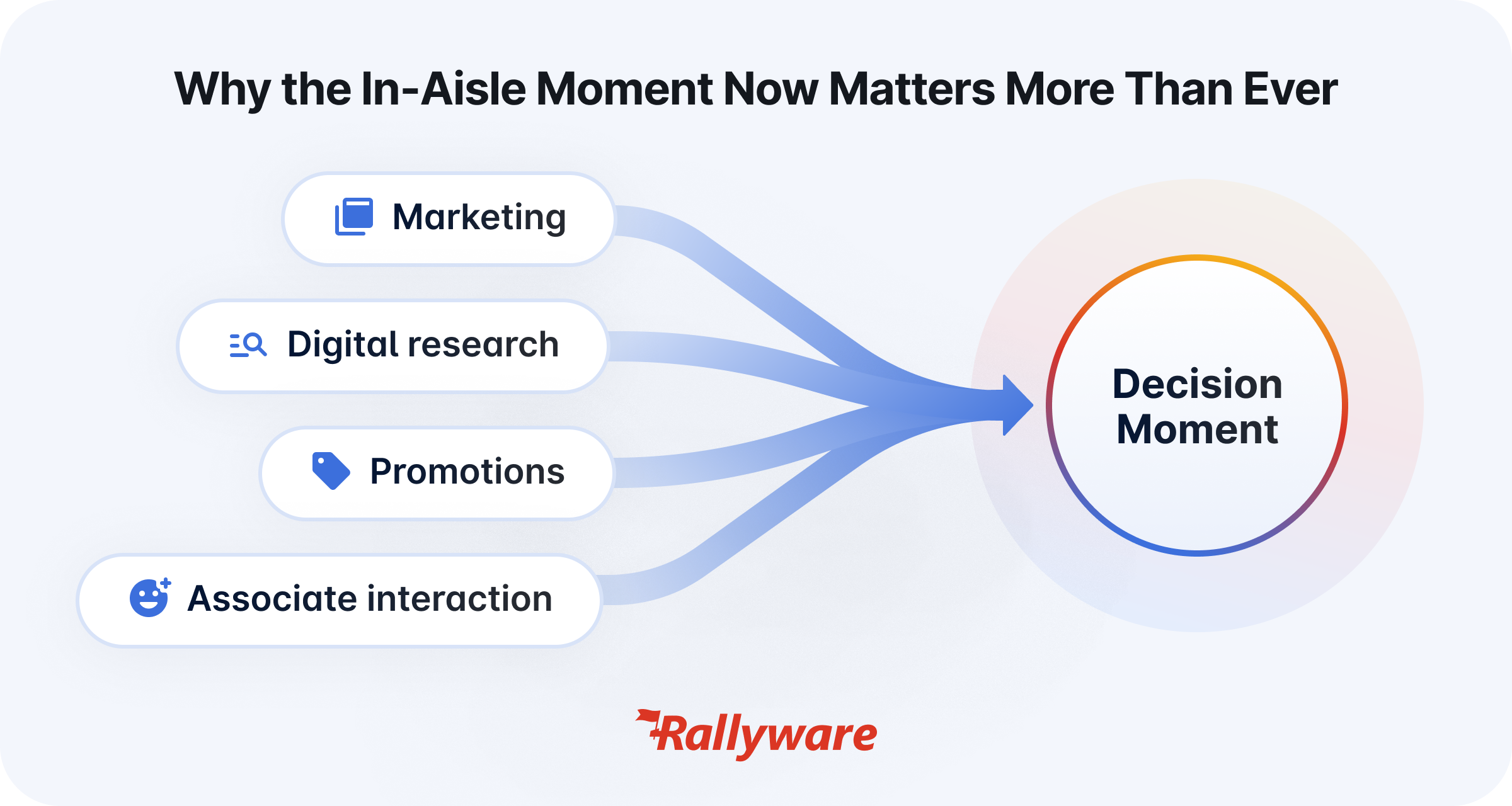
Why the In-Aisle Moment Now Matters More Than Ever
In traditional retail, this moment has always existed. What’s changed is its importance.
Three structural shifts are elevating the in-aisle decision moment from tactical concern to strategic priority:
1. Customers Arrive Pre-Informed and Expect Validation
Today’s shoppers do their homework. By the time they reach the aisle or associate, they aren’t looking for information, they’re looking for confirmation, clarity, and confidence.
According to McKinsey, up to 70% of purchase decisions are finalized at the point of interaction, not earlier in the journey. The associate’s response can either reinforce intent or derail it entirely.
2. Execution Is Now the Bottleneck
Most retailers have strong strategies, competitive assortments, and sophisticated analytics. What separates leaders from laggards is no longer planning, it’s execution consistency at the frontline.
The challenge isn’t knowing what should happen.
It’s ensuring it happens every time, in every location, with every customer.
3. Variability at the Frontline Is Costly
The difference between your best associates and the average ones isn’t marginal, it’s material.
Top performers instinctively:
- Tailor recommendations
- Handle objections confidently
- Translate promotions into value
The long tail does not, and that performance gap directly impacts conversion, margin, and brand perception.
The Hidden Gap in Retail Enablement
Retail organizations invest heavily in:
- Product training
- Sales playbooks
- Promotions and incentives
- Store communications
Yet much of this investment fails to influence behavior at the precise moment it matters.
Why?
Because most enablement is designed for preparation, not performance.
Frontline teams are trained in advance and expected to:
- Recall complex information
- Apply it accurately
- Adapt it to real-time customer needs
All under pressure.
As Harvard Business Review has noted, learning that isn’t reinforced in context decays rapidly. Knowledge delivered days or weeks earlier simply doesn’t survive the realities of live customer interaction.
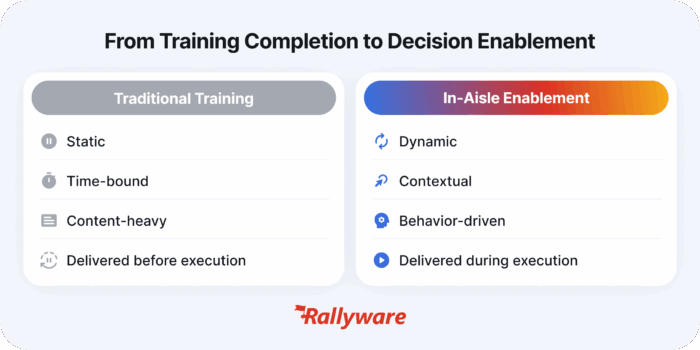
From Training Completion to Decision Enablement
Winning the in-aisle decision moment requires a fundamental shift in mindset:
From: Did they complete the training?
To: Did they make the right decision in the moment?
Leading retailers focus on three core capabilities.
1. Contextual Guidance at the Point of Need
Frontline teams don’t need more content, they need clarity.
That means:
- Product comparisons surfaced when customers hesitate
- Objection-handling guidance triggered by real scenarios
- Promotion and eligibility reminders delivered precisely when relevant
This is not about overwhelming associates. It’s about reducing cognitive load so they can focus on the customer, not the rulebook.
2. Reinforcement in the Flow of Work
Retail is fast-paced. Learning must keep up.
Micro-coaching, short challenges, and ongoing reinforcement, delivered directly in the tools associates already use, help turn knowledge into habit.
According to learning science, repeated application in real contexts is what drives retention and confidence. This is how average performers improve and top performers stay sharp.
3. Closed-Loop Feedback Between Strategy and Execution
The most advanced organizations treat the frontline as a learning system.
They measure:
- Which behaviors drive higher conversion
- Where interactions stall
- How different approaches perform across regions or formats
Those insights inform everything upstream, from training priorities to merchandising strategy.
As Gartner emphasizes, enablement effectiveness is measured not by activity, but by behavioral change tied to outcomes.
What the In-Aisle Decision Moment Looks Like in Practice
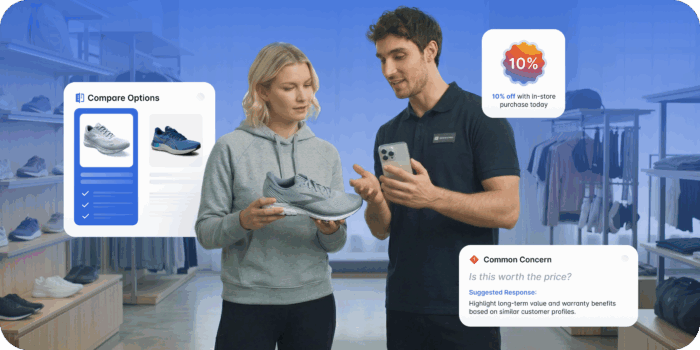
Consider a store associate helping a customer compare two products.
Instead of relying on memory, the associate is supported with:
- A concise differentiation prompt based on proven conversion drivers
- A recommendation aligned to the customer’s needs, not just inventory
Or imagine:
- A real-time nudge reminding an associate of a relevant bundle or promotion
- A targeted coaching moment after repeated missed opportunities
The result is not scripted selling.
It’s confident, consistent execution at scale.
The Strategic Impact for Retail Leaders
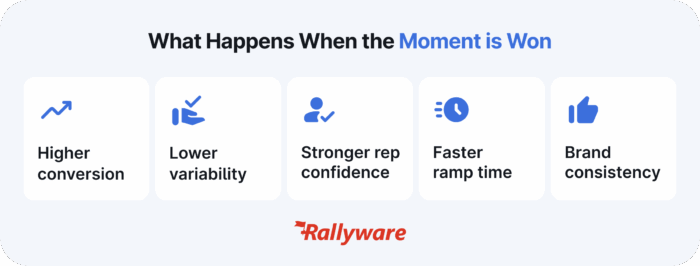
Retailers that invest in the in-aisle decision moment see measurable gains:
- Higher conversion rates without deeper discounting
- Improved consistency across locations and channels
- Faster ramp time for new associates
- Stronger alignment between brand promise and in-store experience
Most importantly, they reduce the risk inherent in variability, turning frontline performance into a predictable growth lever.
How Rallyware Enables In-Aisle Excellence
Rallyware helps retail organizations move from static training to dynamic performance enablement.
By combining:
- Rule-based personalization
- Behavior-driven reinforcement
- Just-in-time guidance
- Outcome-based analytics
Rallyware equips frontline teams to make better decisions, faster, without disrupting the customer experience.
The result is not more training.
It’s better execution, exactly where it matters most.
The Executive Takeaway
The next retail frontier isn’t a new format, channel, or technology stack.
It’s the moment of decision, and whether your frontline teams are equipped to win it.
Retail leaders who focus on the in-aisle decision moment don’t just improve sales metrics. They create organizations where strategy consistently translates into execution.
And in today’s retail environment, that consistency is the ultimate advantage.
FAQ: The In-Aisle Decision Moment
What qualifies as an in-aisle decision moment?
Any live interaction, physical or digital, where a customer’s final choice is influenced by frontline execution.
Is this relevant beyond brick-and-mortar retail?
Yes. The same principles apply to contact centers, clienteling, assisted e-commerce, and omnichannel environments.
How is this different from traditional sales training?
Traditional training prepares associates in advance. In-aisle enablement supports them in real time, during execution.
What KPIs improve when this is done well?
Conversion rate, average order value, associate ramp time, and consistency across locations.
News and Insights on Workforce Training & Engagement
We’re among top-notch eLearning and business engagement platforms recognized for effective training and talent development, helping to empower distributed workforces
Subscribe