From 2% to 15%: Why direct selling is outpacing every other channel with AI orchestration
The 7-Day Advantage: Why Your Onboarding Program Is Optimizing the Wrong Window
For as long as most direct selling organizations have measured onboarding, they’ve measured it in 90-day increments. Ninety-day activation rate. Ninety-day retention. Ninety-day first-order benchmarks. It’s the unit of time the industry was built around, and it isn’t wrong. There’s real value in that window.
But it may be the wrong window to optimize first.
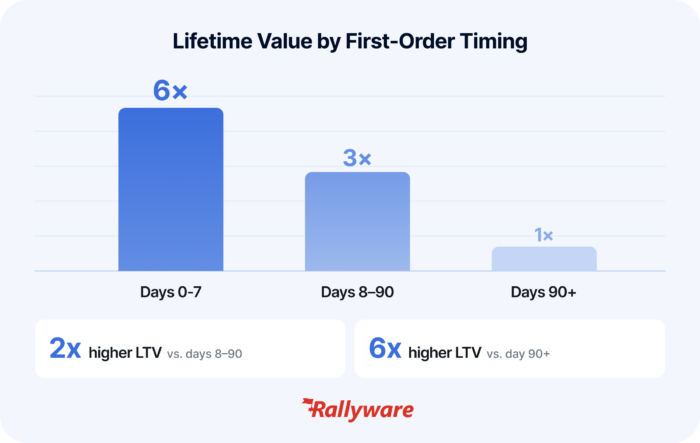
New data shared by Rallyware’s Dan O’Marra and Kristin Pfeil during the first installment of the company’s Direct Selling Webinar Series makes a specific, uncomfortable case: a distributor who places a first order between day 0 and day 7 generates roughly 2x the lifetime value of one who orders between day 8 and day 90, and as much as 6x the lifetime value of one who doesn’t order until after day 90. The same compounding pattern shows up in recruiting, where first-week recruiters produce 2.2x more lifetime recruits, and in retention, where fast-acting cohorts show 81% better retention over the following 12 months.
The 90-day window still matters. But the first seven days are where the trajectory gets set.
The Problem Isn’t Awareness, it’s Infrastructure.
Ask most executives whether early activation matters, and they’ll say yes immediately, usually because they’ve already noticed it in their top performers. As Pfeil put it, “the surprise isn’t that early activation matters, it’s how much it matters.” Once leaders see the lifetime value gap, the conversation shifts from how do we improve onboarding to how do we get every distributor to behave like our best ones do, starting in week one.
That shift exposes a gap most companies haven’t solved. In field conversations, three patterns show up repeatedly:
- The orphan problem. Most onboarding programs assume an active sponsor is guiding the new distributor. In practice, a large share of new joiners, Rallyware’s field data suggests around 70%, don’t have one. They get a login and are left to figure it out alone.
- The one-stop-shop problem. Companies build strong onboarding resource centers, but deliver the same content, in the same sequence, to everyone, regardless of market, rank, or what that distributor has actually done. That’s information delivery, not activation.
- The “we know what good looks like” problem. Most organizations can already describe what their strongest distributors do in week one. What they lack is a repeatable system that produces that behavior at scale, for distributors who don’t have a strong sponsor or a lucky first week.
None of these are training problems or communication problems. They’re execution problems, and they call for a different kind of infrastructure than most companies have built for onboarding.
Four Behaviors, Not Forty Content Modules
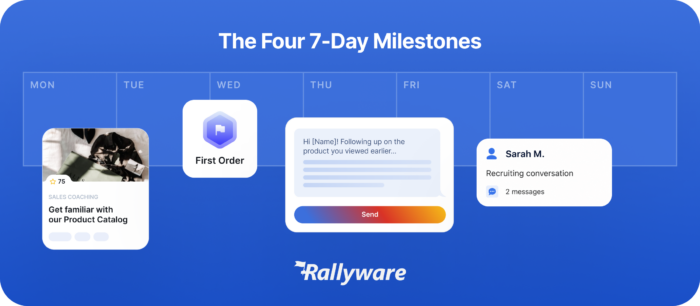
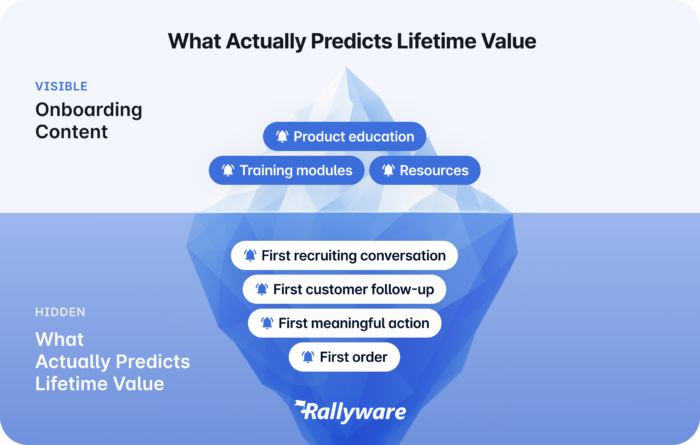
One of the most useful reframes from the webinar: stop measuring onboarding as content completion, and start measuring it as a small number of revenue-relevant behaviors. Across distributors who go on to become genuinely productive, four milestones repeat inside the first seven days:
- A first meaningful action within 48 hours: profile setup, product orientation, understanding the opportunity. Not training completion. An actual action.
- A first order within 7 days: the single strongest predictor, because there’s no second purchase without a first one, and the second purchase is what defines a productive distributor.
- A first customer follow-up within 7–30 days: the behavior that converts a distributor from buyer to seller, and the one most companies have no system to prompt or track.
- A first recruiting conversation in week one: which most organizations assume is a 30- to 90-day behavior. It isn’t. First-week recruiters show 2.2x more lifetime recruits than those who wait.
Direct Selling News reached a similar conclusion in its recent look at AI’s role in onboarding, noting that distributors who make a first sale within 30 days generate roughly five times the lifetime value of those who don’t, the difference, as the piece frames it, between a $400 distributor and a $2,000 one. The specific window differs slightly by methodology, but the underlying finding is the same: time-to-first-sale is one of the strongest predictors of long-term distributor value the industry has, and it has historically gotten far less attention than recruiting or rank metrics.
This isn’t unique to direct selling, either. Product analytics firm Amplitude found that in software, 69% of products with strong day-7 activation also ranked among the top performers three months later, evidence that whatever discipline gets built (or skipped) in the first week tends to compound, whether the “product” is an app or a distributor’s business.
Personalization Isn’t the Answer. Activation Is.
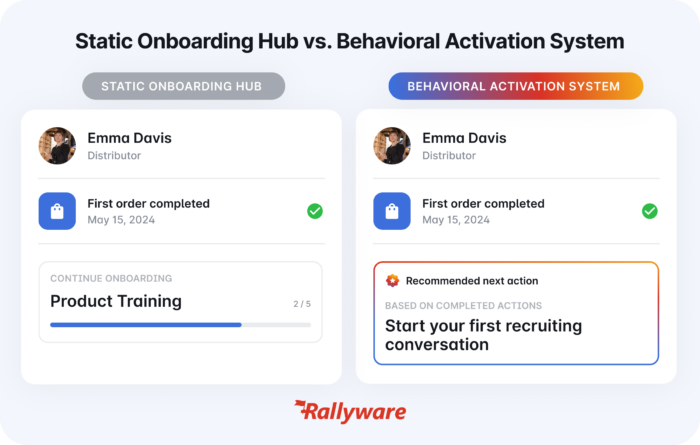
It’s tempting to file this under “we need better personalized onboarding.” Pfeil draws a sharper distinction: personalization is about what a distributor sees. Activation is about what they’re prompted to do next, based on what they’ve actually done, and reinforced until it happens. A distributor who already placed a first order shouldn’t get the same next step as one who hasn’t logged in since day one. That’s not a content problem to solve with more modules; it’s a behavioral orchestration problem.
The good news is that this doesn’t require replacing existing systems. Commerce, CRM, and ERP data already sit somewhere in most organizations. What’s missing is a layer that reads that data in real time, detects when momentum is stalling, and fires the next best action, a nudge, a coaching prompt, a recognition trigger, before the seven-day window closes. That’s a governance and orchestration question, not a technology-overhaul question, and it’s one enterprise onboarding platforms are increasingly built to answer.
Where to Start
Rallyware’s recommendation for leaders convinced by the data but unsure where to begin:
- Get the baseline. What percentage of your distributors place a first order within seven days? If you don’t know, that’s step one.
- Map your top performers’ first week. Most companies already have this data; they’ve just never used it as a design template.
- Find your orphan population. Distributors without active sponsor support are simultaneously your highest-risk and highest-opportunity cohort.
- Pick one behavior, not the whole lifecycle. Start with first-order placement, build a system around ensuring it happens, then expand.
The companies that build this now aren’t just improving onboarding metrics. They’re building a compounding advantage: every distributor activated faster becomes a longer-term seller, a more consistent recruiter, and a more durable part of the network. Not because a sponsor happened to be paying attention, but because a system made sure it happened anyway.
FAQ
Why do the first 7 days matter more than the first 90?
Because early behaviors compound. Distributors who place a first order, make a first customer follow-up, or have a first recruiting conversation within seven days go on to generate significantly more lifetime sales and recruits than those who hit the same milestones later in the 90-day window, even though the 90-day window still carries real value on its own.
Isn’t this just a different way of talking about onboarding?
Not quite. Traditional onboarding measures content completion. A 7-day activation approach measures a small number of revenue-relevant behaviors, first order, first follow-up, first recruiting conversation, and builds a system to reinforce them, regardless of whether a sponsor is actively guiding that distributor.
Does this replace the role of field leaders?
No, it’s designed to extend their reach. Leaders get visibility into which downline distributors are stalling before they have to ask, while the system handles baseline nudges and reminders, freeing leaders to focus on distributors who need real coaching.
What’s the “orphan problem”?
It refers to the large share of new distributors, commonly around 70% in field data, who join without an actively engaged sponsor or upline. Most onboarding programs are built assuming that support exists, which leaves orphaned distributors with no structured path forward.
Do we need new technology to do this?
Not necessarily. Most organizations already have the underlying data in commerce, CRM, and ERP systems. What’s typically missing is an orchestration layer that reads that data in real time and prompts the next best action before the window closes.
How do we measure whether a 7-day activation system is working?
Start with a North Star metric, usually first-order placement or first recruiting activity, and track it by cohort as you roll the system out. Comparing adopting vs. non-adopting cohorts early on lets you validate impact before expanding to longer-term measures like 90- and 120-day retention.
News and Insights on Workforce Training & Engagement
We’re among top-notch eLearning and business engagement platforms recognized for effective training and talent development, helping to empower distributed workforces
Subscribe