Field Enablement Challenges in 2025 and Expert Solutions by Rallyware
Your Distributor Lifecycle Stages Are Fine. Your Transitions Are Failing You.
Most direct selling organizations know their distributor lifecycle cold. Onboarding. Activation. Recruitment. Sales growth. Leadership development. Retention. These stages are mapped, measured, and managed with careful attention to KPIs at each phase.
And yet, revenue keeps breaking in ways that stage-level dashboards never quite explain. A distributor completes onboarding and then disappears. Recruiting numbers look healthy, but new recruits never activate. Sales volume builds and then stalls at the threshold of leadership.
The problem isn’t the stages. It’s what happens between them.
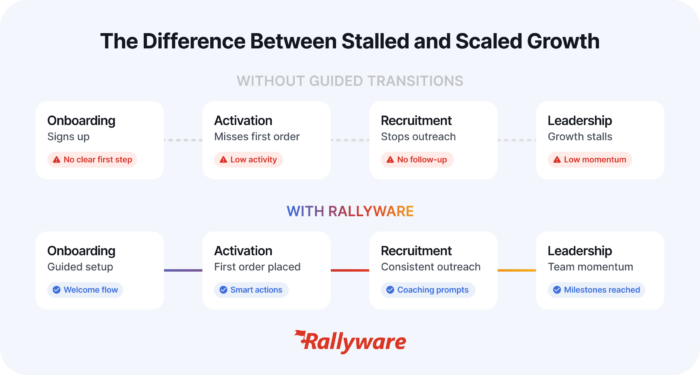
Revenue doesn’t break at the stage level. It breaks in the transitions—those critical windows when a distributor needs to shift from one set of behaviors to another, and the organization has no system in place to make sure that shift actually happens. That gap, largely invisible in traditional reporting, is one of the most significant sources of revenue leakage in direct selling today.
The Stage Trap: Why Good Measurement Produces Bad Outcomes
There’s a seductive logic to lifecycle stage management. You define the phases, set goals for each one, instrument KPIs, and track performance over time. The framework is clean, communicable, and easy to manage at an executive level. For most organizations, it’s the primary lens through which field performance is understood.
But the framework has a structural blind spot: it optimizes for performance within stages, not for the behavioral transitions that connect them. And it is precisely at those connection points where distributors fall through the cracks.
Consider what the data actually shows across high-performing direct selling organizations. The distributors who succeed long-term aren’t necessarily those who enter with the most experience or motivation. They’re the ones who execute a small number of specific behaviors at the right moment during each transition: placing a first order within days of enrolling, beginning to prospect before onboarding ends, maintaining contact with new recruits in the critical window immediately after they join.
These aren’t secrets. Most organizations can identify them, their top performers model them consistently. The problem, as one leadership team recently put it, is that they have the best practice data from their top performers. They just haven’t had the right channel to activate it across the rest of the network.
Where the Transitions Break and What It Costs
Each transition in the distributor lifecycle carries its own failure mode. Understanding them specifically is the first step toward closing them systematically.
Onboarding into Early Activation
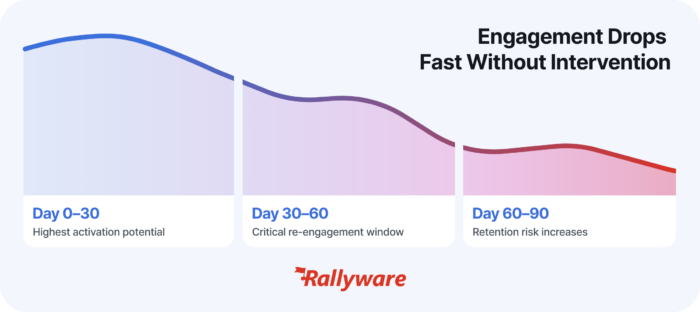
This is the highest-risk transition in the entire lifecycle. A distributor who enrolls but doesn’t take action within the first 48 to 72 hours is significantly less likely to ever become productive. The behaviors that matter here are narrow and time-sensitive: completing required training, placing a first order, logging in consistently during the opening week.
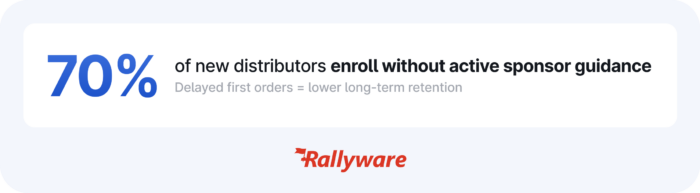
What makes this transition uniquely dangerous is that roughly 70% of new distributors in many organizations are what might be called ‘orphans’—they enrolled without a sponsor actively guiding them. They reach their first day with no clear next step, no personalized direction, and no system telling them what the most important action is right now. The ones who succeed often do so by accident of circumstance—an attentive upline, or a strong intrinsic drive. The ones who don’t simply go quiet.
Recruiting into Recruit Activation
Organizations often celebrate recruiting numbers without tracking what happens next. A recruit who joins but doesn’t activate within their first weeks is almost certain to become a retention statistic. The transition behaviors here—active sponsor support, structured first steps, early prospecting prompts—are well understood in theory and consistently absent in practice.
The deeper issue is consistency. Recruiting is often treated as a milestone event rather than the beginning of a support obligation. When that support doesn’t happen systematically—when it depends entirely on the sponsor’s attention and availability—results become unpredictable at scale.
Selling into Long-Term Engagement
Distributors who reach a productive selling rhythm are the lifeblood of network revenue. But that rhythm is fragile. Inactivity tends to build gradually—a missed week, then two, then a month—until re-engagement becomes much harder than maintenance would have been. The organizations that sustain long-term engagement are the ones that detect the early signals of drift and intervene before the pattern sets.
This is also where the compounding effect of scale becomes most visible. Moving re-engagement rates by even a few percentage points, sustained across a network of thousands of distributors, generates material revenue impact—the kind that shows up in annual results but is nearly impossible to attribute to any single initiative.
Selling into Leadership
The transition from individual seller to team leader is where organizational scaling either happens or stalls. The behaviors required here are categorically different from selling behaviors: monitoring team activity, identifying who needs support, actively coaching downline members. Many high-performing sellers never make this shift, not because they lack capability, but because no one has given them the visibility or the prompts to start thinking and acting like a leader.
Leadership pipelines that stall here don’t just cost individual revenue—they deprive the organization of the leadership leverage that drives exponential network growth.
The Behavioral Architecture That Closes the Gap
The transition problem is, at its core, a behavior problem. The right actions exist. Top performers model them. The gap is that there is no system ensuring those actions happen consistently across the full network, at the right moment, for every distributor.
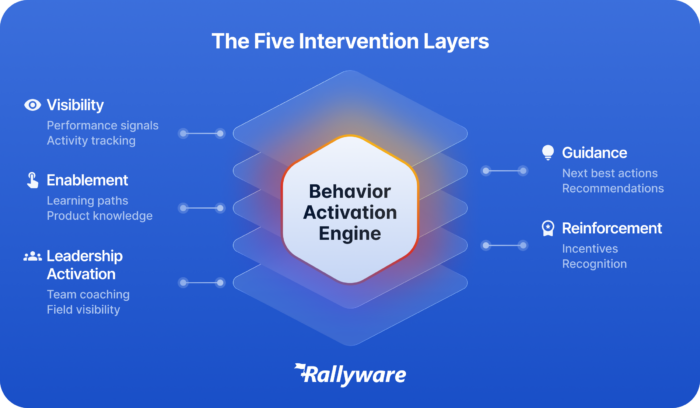
Closing that gap requires thinking about enablement differently—not as a set of training modules delivered at enrollment, but as a continuous architecture of behavioral support that operates across five dimensions:
Visibility: Distributors need to know where they stand and what needs their attention—in real time, not in a quarterly review. A dashboard that shows current momentum, upcoming milestones, and team activity gaps answers the most fundamental question: what should I focus on right now?
Guidance: Knowing where you stand is only useful if you know what to do next. Next-best-action prompts, AI-driven recommendations, and structured task sequences remove the ambiguity that causes distributors to stall. The transition from onboarding to activation doesn’t fail because distributors don’t want to take action—it fails because no one has clearly told them which action to take.
Enablement: Guidance without tools is motivation without traction. The right enablement gives distributors what they need to execute immediately—contact management, messaging templates, product content, sharing tools—so the moment of intent doesn’t evaporate before they can act on it.
Reinforcement: Behavior change requires repetition. Recognition, reminders, incentives, and leaderboards aren’t motivational extras—they’re the mechanism by which episodic action becomes consistent habit. The distributors who build sustainable businesses are the ones whose productive behaviors get reinforced early and often.
Leadership Activation: At scale, behavior is not driven individually—it is driven through leadership. When leaders have real-time visibility into their team’s activity and clear prompts for who needs coaching and when, the behavioral support function multiplies across the entire downline. Leadership activation is what transforms a platform from an individual tool into a network-wide engine.
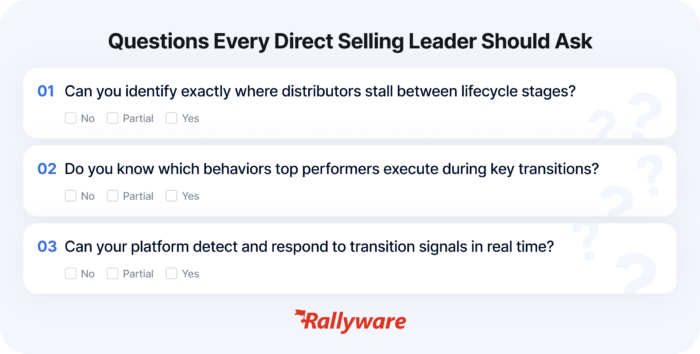
Three Questions Every Direct Selling Leader Should Be Asking
If the transition gap is costing you revenue, the starting point isn’t technology—it’s clarity. Before you can close the gap, you need to know exactly where it is.
- Where are your distributors stalling, and when? Look beyond stage-level retention rates to transition-level behavior data. What percentage of new enrollees place a first order within 72 hours? What percentage of new recruits take their first sales action within 30 days? These specific metrics reveal the precise transitions where intervention is needed most.
- What do your top performers do differently at each transition? The behavioral data already exists in most organizations—it just hasn’t been systematically extracted and operationalized. The actions that differentiate high-performing distributors from average ones are the playbook for your behavioral architecture.
- Does your current platform detect and respond to transition signals in real time? Static training content, periodic newsletters, and annual recognition events cannot close a behavioral gap that opens and closes within days. The organizations that win at scale are the ones whose systems detect the right signals—first login, first order, first recruit—and respond with the right intervention automatically, at the right moment, for every distributor in the network.
The Gap Is Closable. But Only If You Can See It.
The lifecycle stages your organization has defined are almost certainly correct. The goals and KPIs attached to each one are almost certainly reasonable. The problem is that stages don’t self-execute—distributors do. And distributors need more than a destination. They need a system that guides them through the transitions, reinforces the right behaviors at each critical window, and activates leadership support at the moments that matter most.
Predictable revenue doesn’t come from better stages. It comes from better transitions. And the organizations that figure that out—that build the behavioral infrastructure to close the gaps between phases—are the ones that stop wondering why their lifecycle model isn’t delivering and start building networks that compound.
FAQ
Q: What is a distributor lifecycle in direct selling?
A distributor lifecycle refers to the stages a distributor moves through from enrollment to long-term leadership: onboarding and activation, recruiting, selling and productivity, and leadership development. Each stage has distinct goals, KPIs, and required behaviors. The challenge is that most organizations manage each stage in isolation, missing the critical transitions between them where the majority of revenue disruption actually occurs.
Q: Why do distributors drop off after onboarding?
Post-onboarding drop-off is primarily a behavioral gap problem, not a motivation problem. Distributors who don’t receive clear, timely guidance on what to do next—especially those without an active sponsor—have no system telling them which action to prioritize. Research across direct selling organizations consistently shows that distributors who fail to take specific actions (placing a first order, making initial contact with prospects) within their first 48–72 hours are significantly less likely to reach sustained productivity. The fix isn’t more onboarding content—it’s real-time behavioral prompts that activate at the right moment.
Q: What is the difference between lifecycle stage management and transition management?
Lifecycle stage management focuses on goals and KPIs within defined phases—what results are we achieving in onboarding, in recruitment, in sales? Transition management focuses on the behavioral windows between stages—what specific actions need to happen at the moment a distributor moves from one phase to the next, and what systems are in place to ensure those actions occur? Most organizations have robust stage management. Very few have systematic transition management—which is why revenue gaps persist even when stage-level KPIs look healthy.
Q: How does AI improve distributor performance across the lifecycle?
AI enables the kind of personalized, real-time intervention that lifecycle transitions require but manual systems cannot deliver at scale. By analyzing distributor behavior data—login activity, order history, recruiting cadence, team engagement—AI-driven platforms like Rallyware can detect when a distributor is approaching a critical transition, identify which behavior is most likely to drive a positive outcome for that specific individual, and surface a next-best-action prompt at the right moment. This moves enablement from reactive (training delivered on a schedule) to proactive (the right nudge delivered when it matters).
Q: What KPIs should direct selling organizations track to identify transition gaps?
The most revealing transition KPIs are time-based and behavioral: time to first order after enrollment, percentage of new distributors active within the first 30 days, time to first recruit, recruit activation rate within 30 days of joining, re-engagement rate after inactivity, and time to first leadership milestone. Stage-level KPIs (total recruits, total active distributors) tell you what happened. Transition KPIs tell you when the moment broke and why—which is the information needed to intervene before the revenue impact materializes.
Q: What role do leaders play in managing distributor lifecycle transitions?
Leaders are the highest-leverage intervention point in any distributed sales network. When leaders have real-time visibility into their downline’s activity—who is approaching a critical transition, who has gone quiet, who needs a specific type of support—they can intervene with coaching, encouragement, or guidance before inactivity becomes a pattern. The challenge is that most leaders don’t have this visibility, and even when they do, they’re managing large teams across multiple markets without structured prompts for who to support and how. Leadership activation—giving leaders the right data and guidance at the right moment—is what turns individual behavior change into network-wide behavioral consistency.
News and Insights on Workforce Training & Engagement
We’re among top-notch eLearning and business engagement platforms recognized for effective training and talent development, helping to empower distributed workforces
Subscribe