Silent revolution in direct selling: intelligently orchestrated field enablement
Economic Signal Orchestration: The Missing Layer Between Strategy and Revenue
Direct selling organizations don’t struggle with strategy. They struggle with field execution.
Compensation plans are well-designed. Incentives are defined. Training exists. Communications are constant.
And yet, revenue remains inconsistent.
Why?
Because revenue in distributed seller networks is not driven by strategy alone.
It is driven by behavior.
The Real Problem: Signals Without Activation
Every direct selling organization is rich in data.
- Orders
- Activity logs
- Engagement metrics
- Recruiting trends
- Inactivity signals
These are economic signals, indicators of whether revenue-driving behaviors are happening or not.
But here’s the gap:
Most organizations see signals but don’t orchestrate them into action.
They know:
- who hasn’t placed a first order
- who stopped selling
- which campaigns are underperforming
But they don’t systematically convert those signals into timely, behavior-changing interventions.
That’s where performance breaks down.
Behavioral Insight: Revenue Breaks at the Point of Inaction
Across distributor lifecycles, the pattern is consistent:
- New recruits fail to complete early milestones
- Active sellers lack consistent selling rhythms
- Leaders don’t reinforce recruiting behaviors
- Inactive distributors go too long without intervention
The issue isn’t defining the right behaviors. It’s ensuring they happen consistently, at scale.
What Is Economic Signal Orchestration?
Economic Signal Orchestration is the systematic process of:
detecting signals → interpreting behavioral gaps → activating the right actions at the right time
It connects:
Distributor Lifecycle → Behaviors → Signals → Activation → Outcomes
This is the missing operational layer in most direct selling organizations.
Without it:
- Signals remain passive
- Actions are inconsistent
- Revenue is unpredictable
With it:
- Behavior becomes coordinated
- Execution becomes consistent
- Revenue becomes scalable
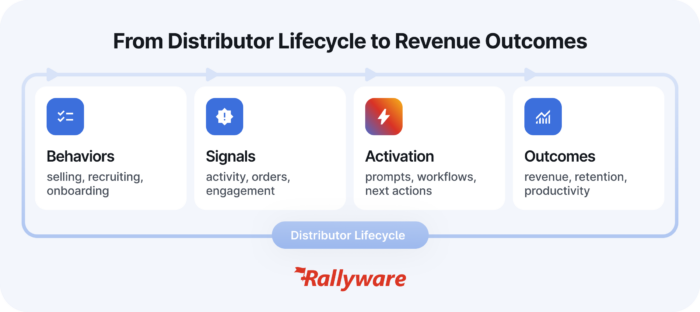
From Signals to Revenue: The Rallyware Activation Model
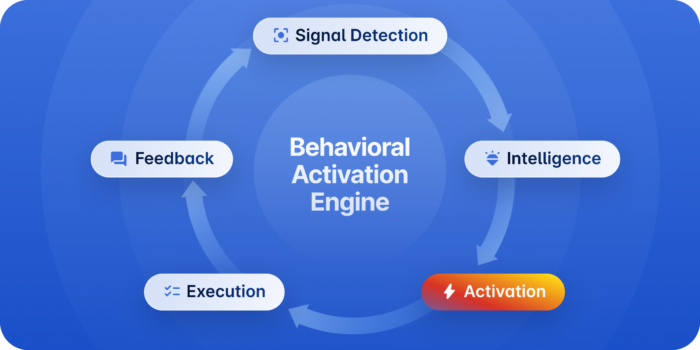
Rallyware operates as a closed-loop behavioral system that transforms signals into revenue outcomes.
1. Signal Detection
Identify behavioral and transactional indicators:
- onboarding progress
- selling activity
- recruiting patterns
- inactivity risks
2. Behavioral Intelligence
Determine:
- what behaviors matter most
- where gaps exist
- what actions should happen next
3. Activation
Trigger:
- guided onboarding
- selling prompts
- campaign actions
- recruiting workflows
4. Contextual Execution
Deliver:
- personalized to-dos
- clear next steps
- “why this matters now” context
5. Reinforcement
Measure:
- behavior completion
- downstream outcomes
- continuous optimization
This is behavioral infrastructure for revenue activation.
What Most Organizations Get Wrong
Many companies attempt to solve execution gaps with more:
- training
- communications
- incentives
- field management
But these approaches share a limitation:
Most systems inform or track behavior. Very few activate it consistently across the network.
This is why:
- training completion doesn’t equal selling
- communication doesn’t guarantee action
- incentives don’t ensure execution
Without orchestration, behavior remains optional.
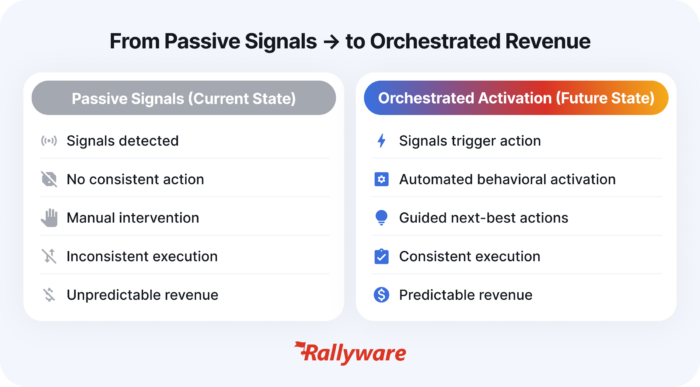
Economic Signal Orchestration in Practice
To operationalize this concept, organizations must shift from passive observation to active orchestration.
1. Identify High-Impact Behaviors
Focus on behaviors that directly drive revenue:
- first order placement
- customer follow-ups
- product demonstrations
- recruiting conversations
2. Map Signals to Behavioral Gaps
For example:
- no first order → onboarding breakdown
- low orders → inconsistent selling behavior
- inactivity → retention risk
3. Activate in Context
Deliver:
- specific actions
- at the right moment
- with clear relevance
4. Reinforce Consistently
Ensure high-performing behaviors are:
- repeated
- measured
- optimized over time
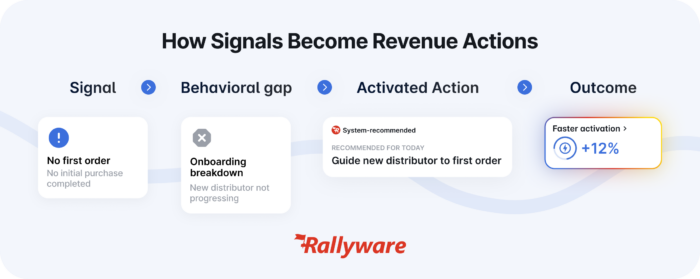
The Strategic Shift
The future of direct selling performance relies on better orchestration.
Leaders must ask:
- Are we just tracking behavior—or activating it?
- Are signals informing decisions—or triggering action?
- Is execution dependent on individuals—or systemized across the network?
Because ultimately:
When behavior becomes consistent, revenue becomes predictable.
Final Thought
Compensation plans define the economic structure.
Economic signals reveal whether that structure is working.
But only orchestration ensures the behaviors happen that make it work.
That is the difference between:
- potential and performance
- activity and outcomes
- growth and stagnation
And it is the layer most organizations are missing.
FAQ
What are economic signals in direct selling?
Economic signals are data indicators, such as orders, activity, or engagement, that reflect whether revenue-driving behaviors are occurring.
What is economic signal orchestration?
It is the process of converting signals into coordinated actions that activate distributor behavior and drive revenue outcomes.
Why is behavior activation critical in direct selling?
Because revenue is directly tied to distributor actions. Without consistent behavior, even strong strategies fail to produce results.
How is Rallyware different from training or CRM systems?
Training and CRM systems inform or track behavior. Rallyware activates, guides, and reinforces the behaviors that produce revenue.
News and Insights on Workforce Training & Engagement
We’re among top-notch eLearning and business engagement platforms recognized for effective training and talent development, helping to empower distributed workforces
Subscribe