Brand-Retailer Collaboration: Elevating the Sales Associate Experience for Competitive Advantage
The Evolution of In-Aisle Tech: What Worked (and What Didn’t)
Retail has never lacked innovation.
From tablets on the shop floor to QR codes on packaging, brands and retailers have spent the last decade experimenting with “in-aisle tech” to bridge the gap between product and purchase.
Some of it stuck. Most of it didn’t.
And here’s the uncomfortable truth:
The problem was never the technology.
It was how (and where) it showed up in the associate’s day.
The Original Promise of In-Aisle Tech
In-aisle tech started with a clear goal:
Enhance the customer experience and drive sell-through at the point of decision.
Think:
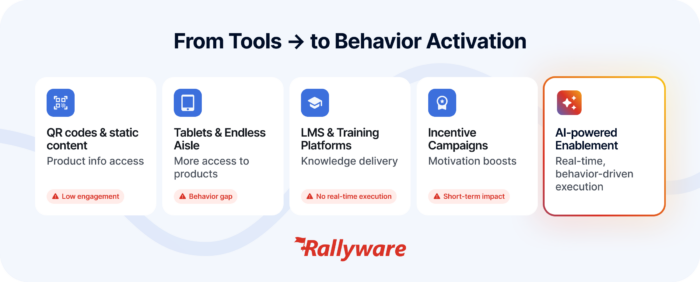
- Tablets for endless aisle access
- QR codes for product education
- Interactive displays for demos
- Mobile apps for associate training
On paper, it made sense. More information → better conversations → higher conversion.
But retail isn’t a controlled environment. It’s fast, fragmented, and human.
And that’s where things started to break.
What Didn’t Work: Tech That Lived Outside the Workflow
Most early in-aisle tools failed for one reason:
They asked associates to stop what they were doing.
Open an app. Scan a code. Search for content. Log into a system.
In theory, it’s simple. In reality, it’s friction.
Retail associates are balancing:
- Customers waiting for help
- Operational tasks like merchandising and restocking
- Constant context switching
When technology adds even a few extra steps, adoption drops fast.
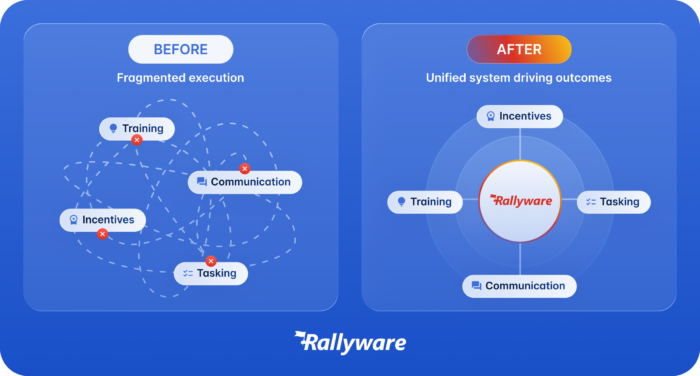
This is exactly why many retail platforms ended up siloed. Tools for communication, tools for learning, tools for tasking, none connected to real behavior or outcomes.
The result?
Low engagement, inconsistent execution, and zero measurable impact.
What Didn’t Work: Incentives Without Context
Another wave of in-aisle tech leaned heavily on incentives.
Gamified campaigns. SPIFFs. Rewards for selling specific SKUs.
And while these drove short-term spikes, they often failed to create lasting performance.
Why?
Because they weren’t tied to knowledge or behavior.
As competitive platforms show, many rely heavily on rewards-based engagement without building deep product understanding or long-term advocacy.
The outcome is predictable:
- Associates push products they don’t fully understand
- Messaging becomes inconsistent
- Customer experience suffers
Short-term lift, long-term erosion.
What Didn’t Work: One-Size-Fits-All Training
Retail training has historically been treated as a one-time event:
- Onboarding sessions
- Static LMS modules
- Occasional brand visits
But retail moves too fast for static knowledge.
TaylorMade experienced this firsthand. Without a unified approach, product training varied across stores, leading to inconsistent knowledge and missed sales opportunities.
Even worse:
- Training wasn’t tied to real-time sales performance
- Associates forgot content quickly
- There was no feedback loop to improve
In-aisle tech that ignored this reality never gained traction.
What Actually Worked: Tech That Fits Into the Flow of Work
The shift we’re seeing now is simple, but powerful:
The best in-aisle tech doesn’t ask associates to do more. It tells them what to do next.
Instead of dashboards and content libraries, leading retailers are moving toward:
- Daily, prioritized activities
- Contextual learning tied to tasks
- Real-time prompts based on performance data
Rallyware calls this behavior-driven enablement.
It’s built on a core idea:
Frontline teams don’t need more content, they need clarity.
The Rise of Sales Performance Orchestration
Modern in-aisle tech is evolving into something bigger:
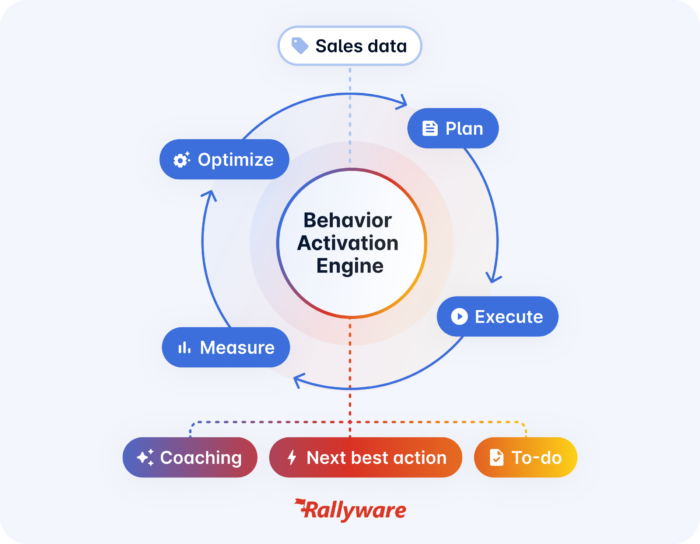
A system that connects:
- Sales data (what’s happening)
- Behavior (what associates are doing)
- Actions (what they should do next)
This is where things start to click.
For example:
- If sell-through drops, associates receive targeted product training
- If a campaign launches, stores get prioritized execution tasks
- If a new hire joins, onboarding adapts to their role and progress
This isn’t hypothetical. It’s already happening.
Rallyware’s platform uses real-time data and business rules to deliver the right activity to the right associate at the right time, turning insights into immediate action.
What Worked: Just-in-Time, Personalized Enablement
The biggest shift in in-aisle tech?
Timing.
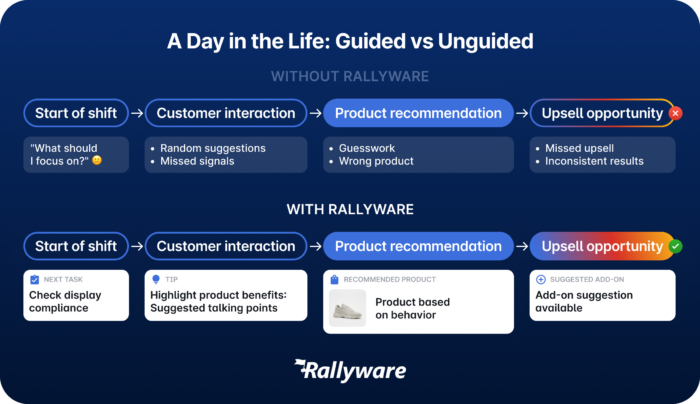
Instead of training before or after the moment of need, leading retailers are delivering enablement during it.
This includes:
- Selling tips and key product information
- Out of stock substitutions
- Upsell recommendations
All delivered at the moment of decision during the customer interaction.
This approach drives measurable outcomes:
- Increased basket size
- Higher product confidence
- Improved conversion rates
When training becomes engaging, accessible, and tied to execution, brands see improvements in both sales performance and customer satisfaction.
What Worked: Connecting HQ Strategy to Store Execution
Another major breakthrough: closing the gap between HQ and the frontline.
Historically:
- Campaigns were designed centrally
- Execution relied on emails, PDFs, and manual follow-up
Today, leading retailers are using in-aisle tech to:
- Deliver campaign instructions directly to associates
- Track execution in real time
- Adjust based on performance data
This creates a continuous loop:
Plan → Execute → Measure → Optimize
And it solves one of retail’s biggest challenges: inconsistent execution across stores.
The Real Lesson: It’s Not About Tech, It’s About Behavior
Here’s the takeaway most teams miss:
In-aisle tech often fails because it’s disconnected from behavior.
Retail performance is driven by thousands of small actions:
- Asking the right question
- Recommending the right product
- Executing the right display
When technology guides those actions, consistently and contextually, it works.
When it doesn’t, it becomes noise.
What Comes Next: AI-Powered Frontline Execution
The next evolution of in-aisle tech is already here:
AI-powered sales performance orchestration.
Instead of static campaigns or manual planning, systems now:
- Analyze performance data in real time
- Predict where gaps will occur
- Automatically trigger the right activities
Rallyware’s AI-native workflows are designed to guide frontline teams with precision, embedding the next best action directly into their day.
This is the shift from technology that informs to technology that drives action.
How Retail Leaders Should Rethink In-Aisle Tech
If you’re evaluating your current stack, start here:
1. Eliminate friction
If it requires extra steps, it won’t scale.
2. Tie everything to behavior
Content without action doesn’t move KPIs.
3. Connect systems to outcomes
Training, tasking, and incentives should work together—not separately.
4. Prioritize timing over volume
The right message at the right moment beats more content.
5. Measure what matters
Focus on sell-through, conversion, and execution—not just engagement.
Final Thought
Retail doesn’t need more tools. It needs systems that turn frontline behavior into performance.
Because in the aisle, there’s no time to figure things out.
Associates need to know exactly what to do, right now.
And the brands that deliver that clarity?
They’re the ones that win.
FAQ
What is in-aisle technology in retail?
In-aisle technology refers to digital tools used on the sales floor to support associates and enhance customer interactions, such as mobile apps, QR codes, and task management platforms.
Why did early in-aisle tech fail?
Most solutions failed because they added friction, weren’t integrated into daily workflows, and didn’t connect to measurable outcomes like sales performance or execution.
What makes modern in-aisle tech effective?
Today’s solutions focus on behavior-driven enablement—delivering personalized, real-time actions and training directly within the associate’s workflow.
How does AI impact in-aisle retail technology?
AI enables real-time personalization, predicting performance gaps and automatically guiding associates with the next best action to improve results.What should retailers look for in in-aisle tech?
Retailers should prioritize solutions that integrate with existing systems, reduce friction, personalize enablement, and directly impact KPIs like sell-through and conversion.
News and Insights on Workforce Training & Engagement
We’re among top-notch eLearning and business engagement platforms recognized for effective training and talent development, helping to empower distributed workforces
Subscribe