How a Retailer Reinvented its Approach to Employee Training & Engagement to Drive Sales by 19%
Stop Assigning Homework: Why Retail Associate Training Should Be Built for Selling
Part 2 of 4 in our Road to NRF series, inspired by Juan Molina’s conversation with Ron Thurston on Retail in America.
Picture a seasonal associate on their fifth shift. They had an hour last week to watch a product video. The delivery is late, someone called out, and they’re covering two departments. A shopper picks up a $400 piece of equipment and asks a question the video didn’t cover.
What happens next has very little to do with how good the training was. It has everything to do with what the training was designed for.
We called it training. It was homework.
Rallyware has spent more than a decade helping brands and retailers educate frontline teams. The biggest lesson from that work, Juan told Ron Thurston, is that “the day in the life of a frontline associate is not conducive to doing homework.”
“We were calling it training,” he said, “but it was actually homework.”
He gave three reasons it breaks down.
Associates aren’t in school. Learning is not their primary job. Selling, restocking, fulfilling orders and helping customers are.
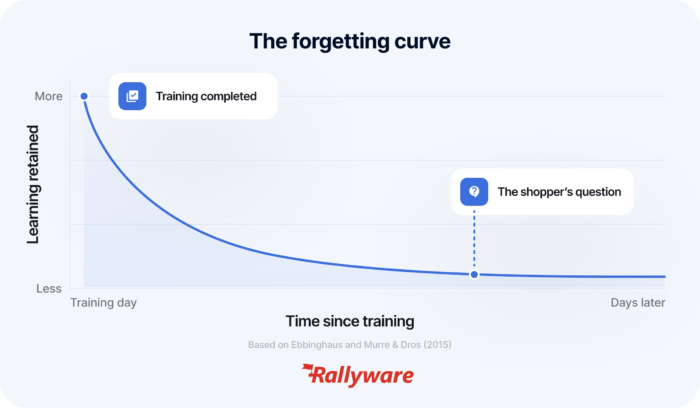
Biology works against retention. The forgetting curve, first measured by Hermann Ebbinghaus and replicated in PLOS ONE in 2015, shows that most newly learned material fades fast without reinforcement. A module completed on Monday is a weak answer to a question asked on Saturday.
The store is chaotic. Ron and Juan both came back to this. Late deliveries, call-outs and coverage gaps mean there is rarely a quiet hour to study. Zebra’s Global Shopper Study found that nearly half of associates are frustrated by how little time they have to help customers, never mind to learn.
On the show, Ron cited data Juan had shared that fewer than 15% of associates engage with voluntary training, and that most of it is forgotten within days. Whatever your own number is, the pattern is familiar: your most engaged learners are usually already your best sellers. The question is what happens with everyone else.
What are you optimizing for?
This is the question Juan kept returning to, and it is the one worth bringing into your next planning meeting.
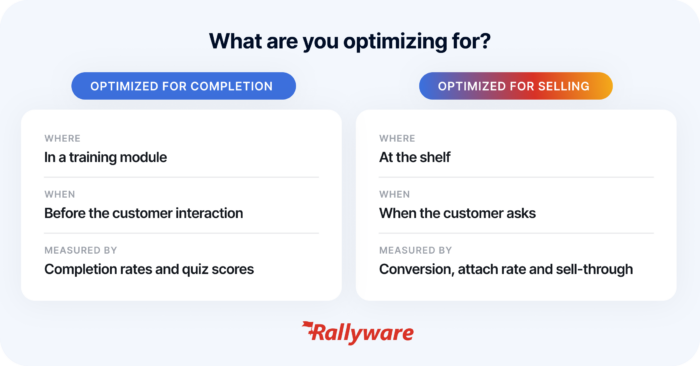
“Are you optimizing for good grades and completion rates, and giving yourself a pat on the back because that piece of content was really engaging? Or are you optimizing for unlocking value when they need it most?”
The distinction matters because the two goals produce different systems. A completion-optimized program builds a library, assigns modules and reports on who finished. A selling-optimized program asks what an associate needs in the ten seconds after a shopper picks up a product, and builds backward from there.
Juan described a company that gives seasonal workers less than seven days of training before they sell a relatively complex jewelry line. No library can close that gap in a week. Only support that shows up in the moment can.
It’s not that training content is bad. As Juan put it, “We haven’t optimized it for what it’s meant for, which is selling.”
The good news: the fuel already exists
Juan describes the first requirement as a “gas tank”: a rich store of product information. Every brand that sells through retail already produces it in PDFs, spec sheets, videos and launch decks.
The work is not creating more content. It’s connecting what exists to the floor, then shaping it with the retailer’s own selling guidelines and brand voice, so an associate can access it in seconds by scanning a barcode or using image recognition on products without one.
That is what Rallyware calls in-aisle sales execution. Learning still has a place, and Rallyware’s platform still delivers it, along with contests that keep teams motivated. But the value is unlocked at the shelf, not in the library.
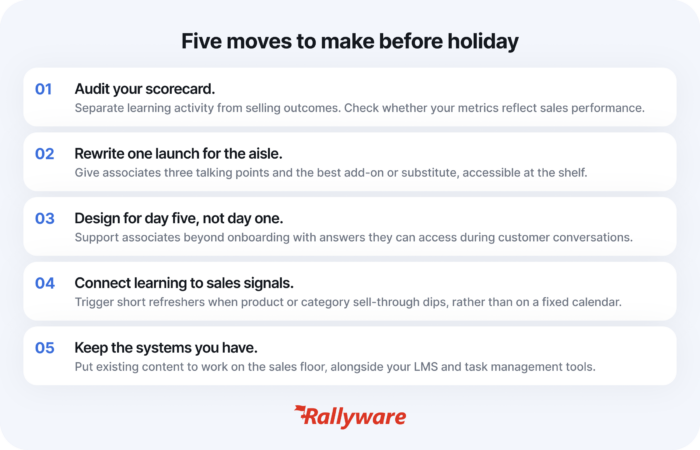
Five moves to make before holiday
- Audit your scorecard. List every metric your enablement team reports. Mark each as “learning activity” or “selling outcome.” If the first column is longer, you know what you’re optimizing for.
- Rewrite one launch for the aisle. For your next product launch, reduce the training to the top three things an associate should say, plus the best add-on or substitute. Make that available at the shelf.
- Design for day five, not day one. Build your seasonal plan assuming associates will forget most of what they saw at onboarding, and give them in-the-moment support instead.
- Connect learning to sales signals. Trigger short refreshers when sell-through dips on a product or category, rather than on a calendar. Orbea boosted lesson attempts by 458% with just-in-time incentives and announcements.
- Keep the systems you have. You don’t need to rip out your LMS or task management platform. As Juan noted, many Rallyware customers keep their existing training tools. The goal is to put that knowledge to work in the aisle.
From homework to help
Shoppers won’t wait while an associate searches the company website. Ron said it best: the bar for information speed is set everywhere else in our lives, until we get to the sales floor.
The retailers that win holiday will be the ones whose associates have the answer in hand when the question is asked. In Part 3, we take on the assumption that makes many leaders hesitate to invest in associates at all: turnover.
FAQ
Why doesn’t traditional retail associate training translate into sales?
It is usually built for completion, delivered away from the sales floor and forgotten before associates need it in front of a customer.
What is the difference between training and associate enablement?
Training delivers content. Enablement puts usable guidance in the associate’s hands at the moment of decision and measures the selling outcome.
How can seasonal associates sell complex products with little ramp time?
By giving them real-time product answers, key talking points and add-on suggestions at the shelf, rather than relying on what they remember from onboarding.
Do retailers need to replace their LMS?
No. In-aisle execution can draw on existing brand and training content and sit alongside current learning and task management systems.
What metrics should replace completion rates?
Conversion, units per transaction, attach rate, sell-through by product and time-to-first-sale for new associates.
News and Insights on Workforce Training & Engagement
We’re among top-notch eLearning and business engagement platforms recognized for effective training and talent development, helping to empower distributed workforces
Subscribe