How a Retailer Reinvented its Approach to Employee Training & Engagement to Drive Sales by 19%
Everyone Built Retail Tech for the Consumer. Nobody Built It for the Associate.
Last month, Rallyware’s Product Marketing Manager, Rebecca sat down with Juan Molina, who has spent nearly 20 years working with retailers and brands, most recently as the architect of Rallyware’s retail go-to-market strategy, for a candid conversation about what’s actually broken in how stores enable their people to sell.
What emerged was a diagnosis. And it started with a question that sounds almost too simple: in a world overflowing with retail technology, why is the one person who physically controls whether a sale happens, the store associate, still largely on their own at the moment it matters most?
Here are the key ideas from that conversation, and why they matter if you’re thinking about how to compete in physical retail over the next few years.
The Origin Story: Training Was Broken, But Not in the Way Anyone Thought
Juan’s entry point into this problem came from a simple directive from Rallyware’s CEO: training only exists to sell things, but it’s never available when someone is in front of you asking a question. How can we fix that?
What followed was roughly 30 to 40 discovery interviews with brands and retailers, looking for the shape of the problem. The answer that kept coming back, consistently enough to be surprising, wasn’t about content or curriculum or platforms. It was about timing and proximity.
“Training really only exists to sell stuff. But it’s never available when someone’s in front of you asking a question, or looking to buy something.“
From the brand side, the frustrations clustered around three things: poor engagement with training materials pushed to retail partners, no visibility into sell-through impact in real time (brands were waiting weeks for data), and a fundamental lack of control over the associate workforce they depended on to represent their products.
From the retailer side, a different version of the same story. A workforce that skews toward part-time, seasonal, and high-turnover, people who are harder to train, less likely to engage with off-floor content, and increasingly outgunned by the consumer standing in front of them. As Juan put it: customers today walk in with AI in their pocket, giving them real-time product information, competitive comparisons, and pricing data. The average associate has less than that.
The 15% Problem: Why LMS Platforms Aren’t the Answer
One of the sharper moments in the conversation came when Juan addressed the traditional approach head-on, including Rallyware’s own legacy as an LMS company.
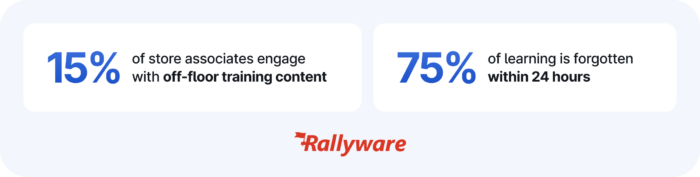
“Regardless of what LMS or what methodology you’re using, you barely get above 15% engagement. You only get about 15% of your workforce to even go into the system.”
The problem isn’t that learning management systems are bad tools. The problem is that they’re off-floor tools being used to solve an on-floor problem. An associate working with a customer doesn’t break away to watch a product video. The training content sits in a database, not adjacent to the moment of decision, and given that humans forget approximately 75% of what they learn within 24 hours, the gap between ‘completed training’ and ‘can sell this product confidently today’ is enormous.
Field training teams, which once filled some of this gap, largely disappeared post-COVID. The brands that had robust in-person training programs cut them for budget reasons and, by 2026, most haven’t fully rebuilt them. The result is a structural void: the mechanism that used to bring product knowledge to the floor is gone, the LMS that replaced it doesn’t reach the floor either, and the associate is left to figure it out.
The Associate Is the Protagonist. The Tech Stack Forgot Them.
The clearest articulation of the core insight came from a conversation Juan recalled with a head of customer experience at a 1,000-store retail chain. The exec wasn’t asking for a more sophisticated LMS or a richer content library. He was asking for something much simpler and much harder to build:
“I need a system that when my associates are in the store, I am personalizing and tailoring—think of like an Instagram feed or a TikTok feed, where I just rock in, look at the feed, and I am now optimizing the 2 or 3 things that they need to focus on for that day.”
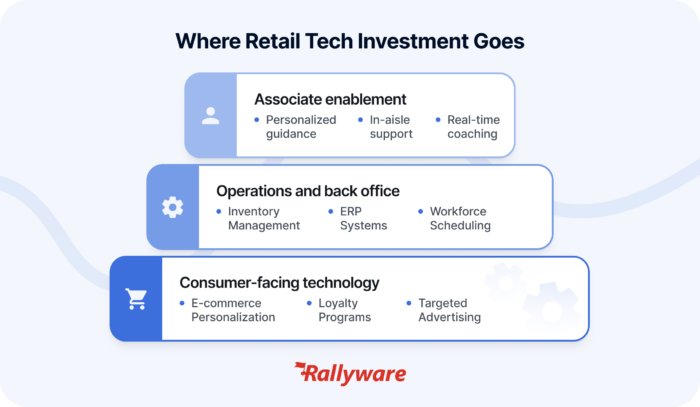
This is the design philosophy that most retail technology has missed entirely. The consumer has been the focus of enormous investment—personalization engines, recommendation algorithms, omnichannel journey mapping. The back office has benefited from ERP systems, inventory management, workforce scheduling, and analytics platforms. But the associate, the person who physically converts or loses the sale, has largely been an afterthought in the technology stack.
As Juan observed: “There’s lots of technology to make life easy for consumers, to make life easy for the ecosystem of a retailer. There’s not a lot that makes it easy for that associate.”
And yet, when brands and retailers both win or lose in the same exact moment, the in-aisle interaction between an associate, a product, and an interested consumer, the person with the most control over that outcome is the associate. Not the merchandiser. Not the trade marketing team. Not the algorithm. The human being standing in the aisle.
What “Getting It Right” Actually Looks Like in 2026
The webinar got specific about what associate-first enablement looks like in practice, and it’s less about new content and more about a fundamentally different relationship between information and timing.
From training to sell to enabling in the moment
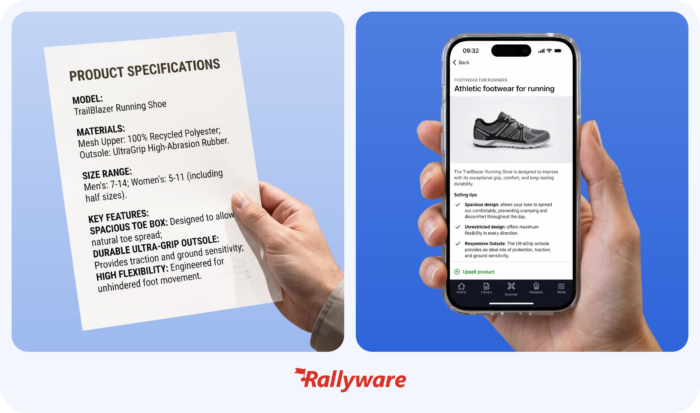
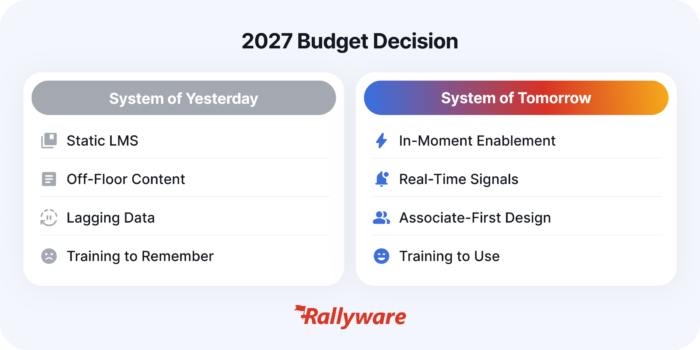
The shift Juan described is from “training to remember” to “training to use.” If no customer is asking about a product today, there is no reason to load an associate with information about it. But the moment that consumer walks into the aisle with clear purchase intent, the associate needs everything, product differentiators, upsell logic, substitution options if the item is out of stock, available in their hand, right now, without friction.
The e-commerce parallel is instructive. Online, if a customer puts product A in their cart, the platform instantly surfaces product B as a complement, and data tells you exactly what percentage of the time that recommendation converts. That same logic, applied to a physical aisle in real time, is what changes the economic equation of in-store selling.
From cost center to revenue channel
One of the recurring themes in the conversation was what happens when you reframe the devices and systems in a store from operational costs to revenue drivers. Today, devices handed to associates are typically treated as cost line items: expensive, occasionally broken, hard to justify. But if each device drives one to two incremental units of sell-through per store per month, the math changes immediately.
“The blessing and the curse of retail is you take a dollar, and if you’ve got a thousand stores, it’s actually multiplied over a thousand stores. If I’m spending a dollar, it’s a thousand. But if I’m making a dollar, it’s also a thousand.”
This is the economic case for associate enablement that doesn’t require a 500% ROI promise. It requires only that you believe one additional sale per store per month is achievable, and then let the math do the rest across your network.
From reactive data to real-time intelligence
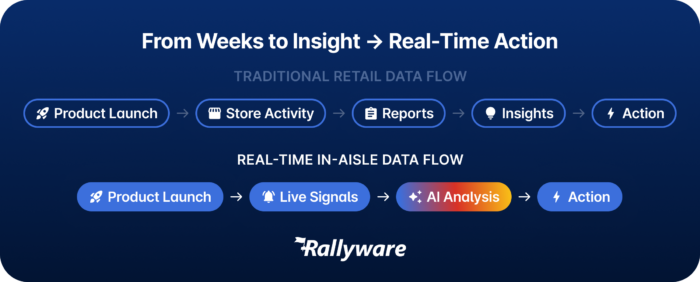
Perhaps the most forward-looking part of the conversation was about data. Today, brands launching a new product into retail wait weeks for sell-through data, by which point the window for in-flight adjustment has already closed. Retailers optimize marketing and advertising spend based on historical patterns, not real-time signals from the floor.
What the in-aisle moment unlocks, when properly instrumented, is a live feed of what’s actually happening between associates, products, and consumers. Which products are being asked about. Where substitutions are being made. Where confidence gaps in the associate team are costing sales. That data, over time, becomes the foundation for the AI-enabled store of the future that every retailer is planning toward, but almost none are currently building the data infrastructure to support.
The Warning for 2026 and 2027 Budget Cycles
The conversation closed on a note that felt more like a warning than a recommendation. As brands and retailers begin allocating 2027 budgets, Juan flagged what he sees as the most common and most costly mistake in the category:
“You’re going to spend money in 2026, and spend IT time and budget—which is very, very valuable for all of these retailers—on implementing a system of yesterday.”
The “system of yesterday” framing is pointed. It’s not a criticism of legacy platforms, it’s a caution against solving a 2026 problem with a 2016 architecture. Organizations scaling their store count, entering new international markets, or spinning up their own retail footprints for the first time are particularly exposed here: they’re making foundational technology choices right now, and if those choices are optimized for content delivery rather than in-moment enablement, they will be difficult and expensive to unwind later.
The broader point surfaced at the end of the webinar is the one that may matter most: this isn’t about more training, more content, or more tools. It’s about helping associates take the right action at the right time, right in the moment that drives revenue. The organizations that understand that distinction now, and build accordingly, will have a meaningful structural advantage over the ones that figure it out two budget cycles from now.
➡ Want to see what associate-first enablement looks like in practice? Watch the Full Webinar
FAQ
Q: What is retail associate enablement?
Retail associate enablement refers to the systems, tools, and processes that equip store associates with the product knowledge, selling guidance, and real-time support they need to convert customer interest into a sale. Unlike traditional retail training—which is typically off-floor, asynchronous, and designed for content delivery—associate enablement is designed for the floor, triggering the right information and actions at the moment a customer is actively engaging with a product.
Q: Why don’t traditional LMS platforms work for retail sales associates?
Learning management systems were built for content delivery and compliance training—not for real-time selling support. The core limitation is proximity: LMS content is accessed off the floor, away from the moment when a customer is making a purchase decision. Research consistently shows that only around 15% of retail associates engage with off-floor training content, and human memory retention drops sharply within 24 hours of learning. The result is a large gap between what associates have been trained on and what they can confidently execute in a live customer interaction.
Q: How does in-store associate enablement affect sell-through rates?
When associates have the right product information, upsell suggestions, and substitution options available at the moment of a customer interaction, conversion rates improve measurably. Even a small shift in walkout rates—moving from 65% of customers leaving without a purchase to 63%—generates significant incremental revenue at scale across a multi-store retail network. The compounding effect of small improvements, multiplied across hundreds or thousands of locations, is what makes in-aisle enablement a material business lever rather than an operational nicety.
Q: What’s the difference between a retail LMS and an associate enablement platform?
A retail LMS is primarily a content repository—it stores training modules, product information, and compliance materials that associates access on their own time, off the floor. An associate enablement platform is designed for the floor itself: it surfaces the right product guidance, coaching prompts, and selling tools at the moment of a customer interaction, personalizes that information to the individual associate’s role and knowledge gaps, and generates real-time data on what’s happening in the aisle. The distinction matters because the problems they solve are fundamentally different.
Q: How should retail and brand leaders think about store tech investments heading into 2027?
The most important question to ask about any in-store technology investment is whether it’s designed for the moment of sale or for administration around the sale. Tools built for the latter—off-floor training systems, retrospective reporting dashboards, static content libraries—reflect an architecture optimized for the way retail worked a decade ago. The organizations that are building competitive advantage in physical retail right now are the ones investing in systems that capture real-time in-aisle signals, enable associates at the moment of customer intent, and generate the data infrastructure that will power AI-driven store optimization over the next several years.
Q: Why is the store associate considered the most important person in the sales chain?
In physical retail, the associate is the only participant in the sales process who is present at the exact moment a consumer expresses purchase intent. Brands have invested heavily in trade marketing and product training; retailers have invested in merchandising, planograms, and foot traffic optimization. But all of that investment converges on a single human interaction—and the outcome of that interaction is determined almost entirely by what the associate knows, how they respond, and what tools they have available. That’s why associate enablement isn’t an HR or training initiative—it’s a revenue strategy.
News and Insights on Workforce Training & Engagement
We’re among top-notch eLearning and business engagement platforms recognized for effective training and talent development, helping to empower distributed workforces
Subscribe