Consumer Experience in Retail: 3 Ways Performance Enablement Helps
Turnover Is Not a Cost of Doing Business: Make the Associate the Protagonist
Part 3 of 4 in our Road to NRF series, inspired by Juan Molina’s conversation with Ron Thurston on Retail in America.
Every retail leader has heard some version of this sentence: “Turnover is 70%, so there’s only so much we can do.”
It sounds like realism. It is actually a decision, and an expensive one.
On Retail in America, Juan Molina and Ron Thurston took aim at what Juan called a “false cost of doing business”: the idea that because frontline associates churn, investing in them is wasted money. Both of them reject it. Here’s why you should too.
The number is real. The conclusion isn’t.
High churn is not new. McKinsey reports that annual turnover among frontline retail workers has been at least 60% for a long time.
But the same research points somewhere more useful. At the best frontline retail employers, comparable-store sales run three percentage points higher than at low performers. The workforce problem and the sales problem are the same problem.
Ron was blunt about the cause. “When you talk about turnover, it’s so self-inflicted often,” he said. “No one chooses to leave jobs and keep joining new companies because it’s fun.” Associates can tell when a company has decided not to invest in them. They won’t say it in the engagement survey. They’ll show it on the floor.
And the shopper feels it. “Sometimes you walk into a retail store and you’re like, ‘Get me out of here,'” Juan said. That walkout isn’t only a lost store sale. As Ron pointed out, it often isn’t recovered online either. It’s a lost brand sale.
Design for the whole bell curve
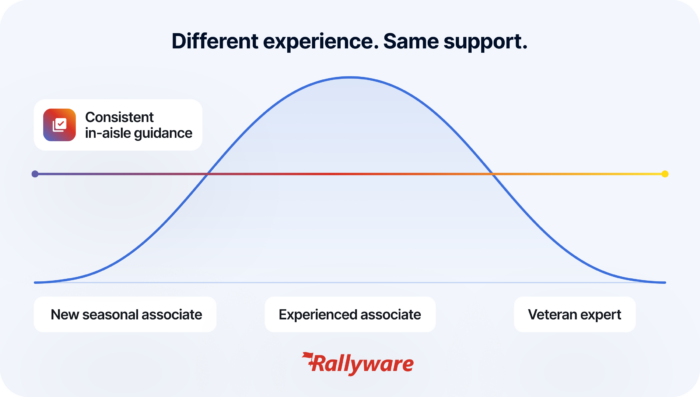
Juan offered a more precise way to think about the frontline workforce. It isn’t just that people turn over. It’s that the range of experience on any given shift is enormous.
At one end is the owner of a specialty shop who knows every product. At the other is a weekend associate, a seasonal hire or a student home for the holidays. Big-box retailers serve customers across that entire bell curve every day.
Now layer on product complexity. Anyone can sell sneakers, Juan noted, but the pool of associates who can confidently sell a golf club gets much smaller. He described a recovery-equipment brand whose products are bulky and technical. Associates avoid them, not because they don’t care, but because they’re intimidated.
“We don’t like to say ‘I don’t know’ or look stupid,” Juan said. “So instead of doing that, we just don’t engage.” The associate pretends to be busy. The shopper leaves.
That is an execution gap, not a people problem. And it’s solvable.
Give every associate an easy button
The goal is not to turn every associate into an expert overnight. It’s to make sure expertise is available to whoever is standing in the aisle.
Juan described it simply: an easy button that, for any product a shopper picks up, surfaces the top three things to say and the best combos or upsells. Retailers already have the data on what converts. When a product goes into the cart, they know which add-on is accepted and how often. That intelligence just hasn’t reached the floor.
Shoppers want this too. Zebra’s Global Shopper Study found that 71% of shoppers have a better experience when associates use the latest technology to help them, and 87% of associates agree they could provide a better experience with generative AI.
When the brand’s voice and the retailer’s selling guidance are present in every aisle, a seasonal worker and a 10-year veteran can deliver a consistent experience. That is how you make the associate the protagonist, as Ron described them, rather than the weak link.
Let’s be honest about the motive
Juan was clear that this isn’t altruism. Frontline associates have been under-equipped for years, and that matters. But the point is commercial: more sell-through, larger baskets and fewer walkouts.
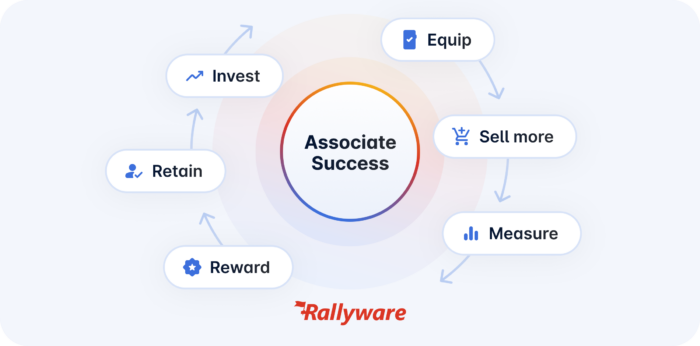
The beautiful part, as Ron framed it, is what happens once the investment shows up in the data. “All you want to do then is invest more.” Better tools lead to better results, which justify better pay, incentives and support. That is a flywheel, not a cost center. Rallyware customers have reported a 43% boost in associate retention alongside faster onboarding.
Four moves to break the “they’ll leave anyway” cycle
- Segment your turnover. Separate seasonal, voluntary and involuntary exits by store and role. A blended rate hides where the real problem lives.
- Find your “scary” products. Ask store managers which products associates avoid. Those categories are your fastest wins for real-time guidance.
- Measure confidence, not just completion. Track how often associates engage with complex products and whether those interactions convert.
- Share the win with the associate. Tie spiffs, contests or recognition to the selling outcomes the guidance creates, so associates see the payoff too.
The protagonist deserves a better script
Turnover will always exist in retail. Abandonment doesn’t have to. When every associate can answer the question in front of them, the shopper stays, the brand wins and the associate has a reason to come back tomorrow.
In Part 4, we tackle the question every CFO asks next: how do we pay for it?
FAQ
What is the average retail associate turnover rate?
McKinsey reports that annual turnover among frontline retail workers has been at least 60% for many years, with large variation by role, store and season.
Does high turnover justify lower investment in associates?
No. Research links strong frontline employers to higher comparable-store sales, and under-equipped associates are more likely to disengage and lose sales.
How can retailers support associates with very different experience levels?
By giving every associate real-time access to product information, talking points and add-on suggestions, so performance doesn’t depend on tenure alone.
Why do associates avoid certain products?
Complex or technical products create a fear of looking uninformed. Without in-the-moment support, associates often choose not to engage.
How does associate enablement affect retention?
Associates who feel equipped and see their results recognized are more likely to stay. Rallyware customers have reported a 43% boost in sales associate retention.
News and Insights on Workforce Training & Engagement
We’re among top-notch eLearning and business engagement platforms recognized for effective training and talent development, helping to empower distributed workforces
Subscribe