The Nudge That Changed Everything: Transforming Sales Performance
The AI-Powered Store Is Coming. Almost No One Is Ready.
Every retail conference this year has an AI keynote. Every brand deck has a slide with a glowing storefront and the words “the store of the future.” Nearly 9 in 10 retail and CPG companies are now actively using or testing AI in some form, according to McKinsey. The intent is real.
The readiness is not.
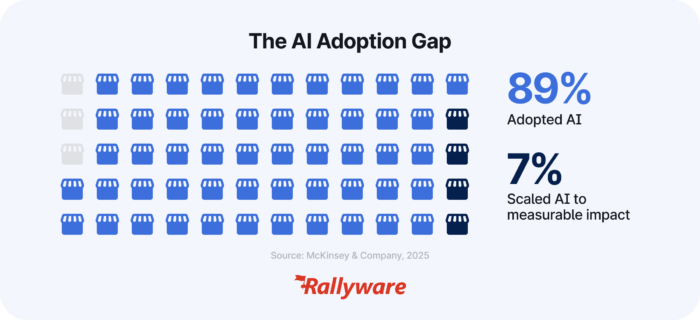
Here’s the uncomfortable part: almost none of that AI investment is pointed at the aisle. It’s pointed at forecasting, pricing, chatbots, and personalized email. Useful work, but it skips the one moment where retail actually happens: a shopper standing in front of a shelf, deciding whether to buy. McKinsey’s own research shows the adoption gap plainly: 89% of retailers have adopted AI somewhere in the business, but only 7% have scaled it to the point of measurable profit impact. That’s not a technology problem. That’s a data problem, and it starts with a signal almost nobody is capturing.
The store has no data layer, and that’s the real gap
E-commerce has spent 20 years instrumenting every click, scroll, and cart abandonment. Physical retail has almost none of that for the moment that matters most: the in-aisle interaction between a shopper and an associate. You can tell me your online bounce rate to the decimal point. Can you tell me what your associate said to the customer who walked out of aisle 12 without buying?
Most retailers can’t, and that’s the blind spot AI can’t fix on its own. A model is only as good as the behavioral signal feeding it, and right now the store floor is the least instrumented square footage in the entire retail stack.
What “behavioral signals” actually means in a store
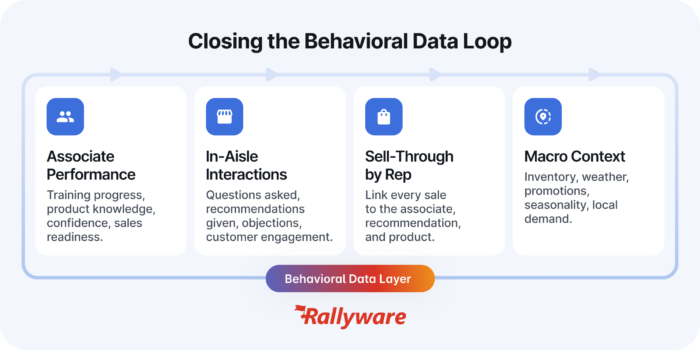
This isn’t abstract. The signals a brand or retailer needs to build a genuinely AI-powered store fall into a few concrete buckets:
- Associate-level performance data: what each associate knows, how confidently they sell it, and where the gaps are. Not just whether they clicked through a training module.
- In-aisle interaction data: what happens between “customer enters” and “customer decides,” captured in a structured, queryable way instead of living only in an associate’s memory.
- Sell-through by rep, not just by store: today most retailers can tell you a store’s numbers. Almost none can tell you which associate, on which shift, moved the needle.
- External context data: weather, local social trends, current events, and inventory fluctuations by geography are the macro signals that should be shaping what an associate recommends in real time, and currently aren’t.
Without these, “AI in retail” is a forecasting tool bolted onto a store that still runs on tribal knowledge and good intentions.
What this unlocks, once it exists
Once that data layer is in place, the use cases stop being hypothetical.
For retailers, that means real-time recommendations shaped by what’s actually happening around the store right now, like a heat wave driving demand for a category, a viral trend spiking interest in a product, inventory shifting by geography. It means predictive flags before an associate’s performance drops, not a quarterly review after the fact. And it means connecting the store’s existing systems, workforce management, foot traffic, inventory, POS, into something that acts, instead of six dashboards that each tell a partial story.
For brands, the same data layer changes a different conversation entirely. Instead of guessing at sell-through, a brand can see predictive sell-through by retailer, region, and store, tied to how associates are learning, earning, and selling that brand’s product specifically. A field rep stops guessing which doors need a visit and starts seeing exactly which stores have an easy win sitting on the table, and which ones are quietly falling off track before the quarter ends.
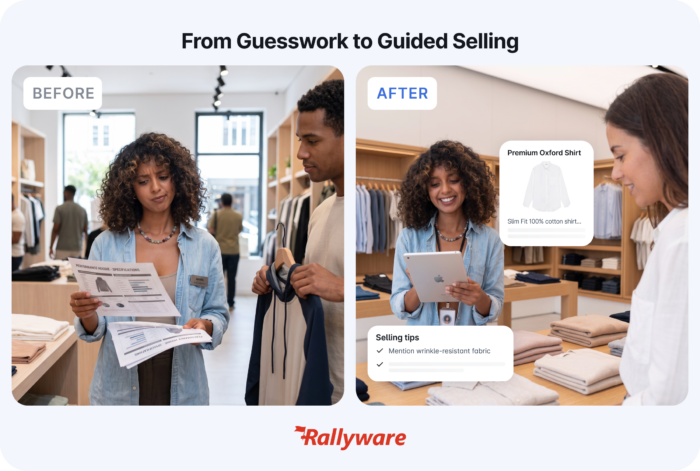
None of this replaces the associate. It arms them. The associate becomes the interface between all that data and the actual human being standing in the aisle.
Why this matters now, not eventually
The urgency here isn’t manufactured. Shoppers already carry AI-powered product research in their pocket before they ever reach for a store associate. The knowledge gap between customer and associate has quietly flipped, and the retailers who close it first will set the pace for everyone else. NVIDIA’s most recent retail research found that almost 9 in 10 retailers have already moved past the “should we” conversation and into active AI engagement. The competitive window here is not decades. It’s quarters.
The brands and retailers who win the next five years of physical retail won’t be the ones with the flashiest AI pilot. They’ll be the ones who quietly built the unglamorous layer underneath it first: real behavioral data from the floor, at the associate level, in real time.
That’s the store of the future. It starts with knowing what’s actually happening in the store of today.
FAQ
What does “AI-powered store” actually mean in retail?
It means a store where decisions on the floor, like recommendations, staffing, and coaching, are shaped by real behavioral and performance data instead of habit or memory. It requires a data layer that captures what happens in the aisle, not just at the register.
Why are most retailers not ready for AI in the store, despite high adoption rates?
Adoption and readiness are different things. McKinsey research shows 89% of retailers have adopted AI somewhere in the business, but only 7% have scaled it to measurable impact, largely because the underlying behavioral data from the store floor doesn’t exist yet.
What behavioral data do retailers need to capture for AI to work in-store?
At minimum: associate-level performance and knowledge data, in-aisle interaction data, sell-through broken out by individual rep, and macro context like weather, local trends, and inventory shifts by geography.
How is this different from AI in e-commerce?
E-commerce has had 20 years of instrumented behavioral data: clicks, scrolls, cart abandonment. Physical retail has almost none of that for the in-aisle moment, which is why AI has been easier to deploy online than on the sales floor.
News and Insights on Workforce Training & Engagement
We’re among top-notch eLearning and business engagement platforms recognized for effective training and talent development, helping to empower distributed workforces
Subscribe