Foot Traffic Is Gold. Are You Mining It?
Your customer got up this morning, got in their car, drove to your store, and walked through your door. That is not passive browsing. That is intent. It is one of the most powerful purchase signals in retail—and most brands and retailers are squandering it.
Today, 80% of brand revenue still happens inside a physical store. Not on an app. Not through a website. In a store. And yet, when we look at what’s actually happening at the moment a customer stops in front of a product and considers buying it—the in-aisle decision moment—there is a startling void. No real-time intelligence. No brand voice. No enablement. Just a hope and a prayer that the right associate happens to walk by.
That void is costing brands and retailers millions of dollars every quarter. And it’s time to close it.
The Problem: You’re Investing at the Top of the Funnel and Going Dark at the Bottom
Consider what brands invest to get a customer into an aisle. Trade marketing budgets. Planogram fees. Brand collateral. Field sales teams—or what’s left of them after the post-COVID reset. All of that investment is designed to attract foot traffic and earn shelf space.
But here’s where the math breaks down: once that customer is standing in front of your product, you lose all visibility and influence. You have no idea whether the store associate helping them has ever heard of your product—let alone whether they can articulate why it’s the right choice. You won’t find out if the sale happened for another four to eight weeks, when the sell-through data finally comes in.
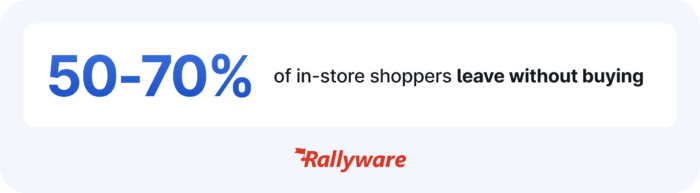
The data on this is sobering. Industry research consistently finds that up to 70% of shoppers who walk into a store leave without making a purchase. And because foot traffic is already hard-won—today’s consumer doesn’t go to the mall to browse; they go with intent—that walkout rate isn’t a minor inefficiency. It’s a structural revenue leak.
As the National Retail Federation notes, frontline associate knowledge and confidence directly correlates with conversion rates and basket size. Yet the systems brands and retailers use to develop that knowledge—static LMS platforms, annual training modules, PDF product sheets—were never designed for the speed of a real customer interaction.
Why This Moment Has Never Mattered More
The store isn’t dying. It’s evolving—and becoming more decisive. The casual mall visit is largely a relic. When a consumer walks into a store today, they have already done their research online. They may know the brand, the category, or exactly which product they think they want. The purchase intention is high.
That creates both an opportunity and a threat. The opportunity: a high-intent shopper is far more likely to convert than someone passively scrolling a product page at midnight. The threat: if your brand’s story isn’t being told accurately and compellingly at the exact moment that customer is weighing their decision, a competitor’s product—right there on the next shelf—will tell its story instead.
This dynamic is further complicated by associate turnover. The associate standing in that aisle today may have started last week. They may be working their first retail job. They almost certainly haven’t absorbed everything in your brand’s training portal—and even if they had, that content isn’t accessible to them in the moment they need it most.
The store operator’s problem is just as acute. Store managers are juggling daily operational chaos—staffing gaps, logistics issues, customer complaints—while being expected to drive maximum sell-through per shift. They have foot counters. They know how many people walk out. What they don’t have is any lever to pull at the moment of decision.
Brand Voice Belongs in the Aisle
The insight that changes everything is deceptively simple: the in-aisle decision moment is not a training problem. It’s a selling problem. And right now, nobody is solving it.
Think about how programmatic advertising works online. A consumer visits a product page, signals intent, and within milliseconds, the right ad is served across every channel they touch. The speed and precision of that match is why digital advertising budgets keep growing. Now ask yourself: why does that intelligence and responsiveness vanish the moment a customer walks into a physical store?
At Rallyware, we call this the in-aisle decision moment—and it is the next frontier of retail performance. It’s the intersection of three forces that have never been brought together before: the brand’s voice (what they need said about their product, right now, in this aisle), the associate’s capability (their readiness to say it confidently and accurately), and the customer’s real-time intent (what they actually walked in looking for).
When those three align—and only when they align—does the sale reliably happen.
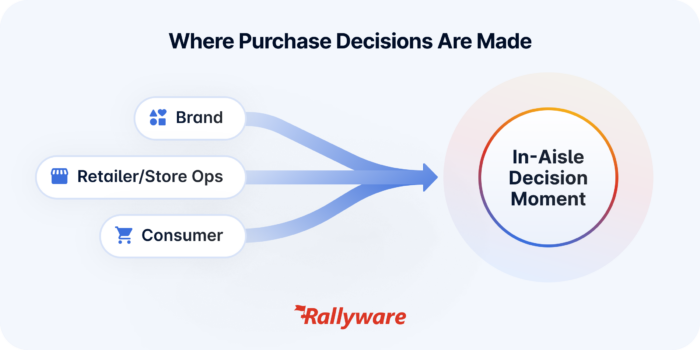
Rallyware’s platform is built to make that alignment possible at scale. Not by adding more content to a training library. Not by deploying more field sales reps. But by putting the right brand intelligence directly into the hands of the associate, at the exact moment a customer expresses interest—with smart upsell and substitution logic built in, so the associate isn’t just knowledgeable, they’re a genuine advisor.
For the brand, this means your voice is present in every aisle, at every retailer, every time a customer shows up. For the retailer, it means your associates perform like your best salesperson—regardless of when they started or what they’ve managed to retain from their onboarding. And for the consumer, it means the interaction they have in that aisle is actually worth having.
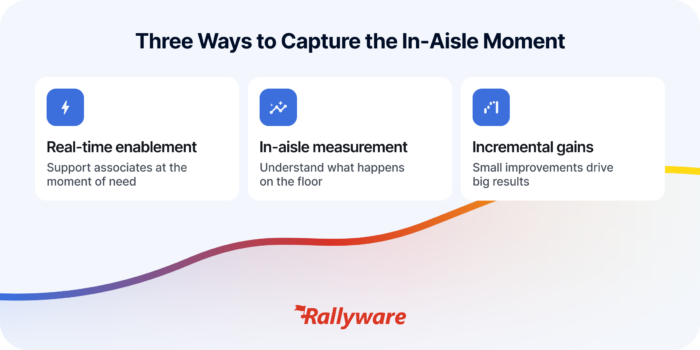
Three Ways to Start Capturing the In-Aisle Moment
Whether you’re a brand fighting for shelf influence or a retailer trying to drive incremental sell-through, here are the practical shifts that make the biggest difference:
- Stop thinking of training as a separate event.
- The associate standing in front of a customer doesn’t have time to recall a module they completed six weeks ago. Real enablement has to happen at the moment of need—lightweight, contextual, and delivered through the device already in their pocket. If your training strategy isn’t designed for the floor, it isn’t designed for selling.
- Measure what happens in the aisle, not just what ships from the warehouse.
- Sell-through data tells you what happened. In-aisle intelligence tells you why. Brands that can track associate engagement, product knowledge gaps, and real-time customer interactions by store and by shift can make mid-course corrections before the quarter ends—not after.
- Think in increments, not overhauls.
- Moving your walkout rate from 65% to 64% sounds modest. Across 500 stores, over a full selling season, that single percentage point is a material revenue number. The opportunity in retail isn’t a single transformational shift—it’s a systematic, sustained improvement in a moment that happens thousands of times a day.
The Gold Is Already There
Every consumer who walks through your door has already done something remarkable—they chose to show up. The question isn’t whether the opportunity exists. It’s whether you have the infrastructure to capitalize on it at the moment it matters most.
The in-aisle decision moment is the last unsolved problem in retail performance. It sits at the intersection of brand strategy, associate enablement, and customer experience—and right now, most organizations are leaving it entirely to chance.
Rallyware is building a future where your brand is always represented exactly the way you want, at every store, at the exact moment every consumer needs to hear it. We’d love to show you what that looks like in practice.
See how Rallyware helps retailers and brands activate the frontline at the in-aisle decision moment.
Frequently Asked Questions
Q: What is the in-aisle decision moment in retail?
The in-aisle decision moment is the window of time when a consumer is physically in a retail store, standing in front of a product, actively deciding whether to purchase. It’s the highest-intent moment in the retail journey—and the moment brands and retailers have historically had the least ability to influence. Rallyware’s platform is specifically designed to enable brands and associates to show up effectively in that window.
Q: Why do so many in-store shoppers leave without buying?
Multiple factors contribute to high walkout rates, but research consistently points to a gap in associate readiness. When a store associate can’t confidently explain the difference between two products, make a relevant recommendation, or address a customer’s specific need in real time, the customer often leaves without committing. High associate turnover (60–100% annually in retail) means this gap is persistent and structural, not episodic.
Q: How can brands influence what happens inside a retailer’s store?
Traditionally, brands used field sales teams and static training materials to influence associate knowledge at retail partners. Both approaches have significant limitations—field teams are expensive and can’t scale across thousands of stores, and static training content isn’t accessible or actionable in the moment of a live customer interaction. Modern performance enablement platforms like Rallyware allow brands to deliver real-time product intelligence, upsell guidance, and brand messaging directly to associates at the point of sale—turning every aisle into an extension of the brand’s voice.
Q: What’s the ROI of improving in-store associate performance?
Even modest improvements in associate performance compound significantly at scale. Moving a walkout rate from 65% to 64%—a single percentage point—translates to meaningful revenue uplift when applied across hundreds or thousands of locations. Similarly, increasing average sell-through by even one additional unit per store per month can represent millions of dollars in incremental brand revenue annually. The key is instrumenting the in-aisle moment so that improvement is measurable, repeatable, and continuously optimized.
Q: How is this different from traditional retail training?
Traditional retail training is designed to be completed in advance—through LMS platforms, video modules, or product sheets—and is rarely accessible or relevant in a live selling situation. Rallyware’s approach shifts the model from ‘train and hope’ to ‘enable in the moment.’ Instead of asking an associate to recall training they completed weeks ago, the platform surfaces the right product information, competitive differentiators, and recommended talk tracks at the exact moment a customer is standing in front of the product. It’s not training to pass a test—it’s enabling to make a sale.
Q: Does this approach work for both brands and retailers?
Yes—and the value proposition is distinct for each. For brands, Rallyware provides a presence in the aisle they’ve never had before: real-time brand voice, product intelligence, and sell-through visibility across all retail partners. For retailers, it means associates perform consistently at a higher level, customers have better experiences, and store-level sell-through improves without adding headcount. When both sides are enabled through the same platform, the alignment between brand intent and retail execution becomes a genuine competitive advantage.
News and Insights on Workforce Training & Engagement
We’re among top-notch eLearning and business engagement platforms recognized for effective training and talent development, helping to empower distributed workforces
Subscribe