Latest Research: Digital Transformation of Direct Selling During & Post-Quarantine
Your Best Distributors Aren’t More Talented. They’re More Consistent.
Every direct selling organization has a version of the same conversation. Leadership looks at the field and asks: why do a handful of distributors consistently outperform everyone else, while the rest, armed with the same products, the same compensation plan, and often the same training, stay flat?
The instinct is to answer with a talent story. Some people are natural sellers. Some aren’t. But that story doesn’t hold up under scrutiny, and it’s an expensive one to keep believing, because it points organizations toward the wrong fix: more content, another webinar, a refreshed onboarding deck.
The real answer is less flattering to the “born seller” myth and far more useful: productivity in direct selling is a behavioral consistency problem, not a talent gap. And it’s solvable.
The Behavioral Gap Hiding Inside Every Flat Sales Month
Between campaign cycles and incentive pushes, most direct selling organizations manage productivity reactively. A dip in field activity gets noticed after it shows up in the numbers, usually a month or a quarter too late to do much about it. In the meantime, distributors simply aren’t consistently performing the behaviors that differentiate top performers: timely customer follow-up, regular outreach, and steady order placement.
This isn’t unique to direct selling. Recent sales productivity research covering more than 4 million opportunities and $54 billion in pipeline found that a small share of reps generate the overwhelming majority of revenue, with productivity gaps between top and average performers now exceeding 8x. Direct selling has the same skew, just distributed across a much larger, more decentralized field, which makes the problem harder to see and even harder to manage by hand.
The gap doesn’t show up because distributors don’t know what to do. Most have been trained. Most have access to scripts, product content, and a compensation plan that clearly rewards the right actions. The gap shows up because knowing and doing are two different systems, and only one of them is being actively managed.
Why Training Alone Was Never Going to Close It
Habit and behavior researchers have shown that new actions typically take on the order of two months of repetition before they become automatic, closer to 66 days on average, and longer for more complex behaviors. A single onboarding module or a quarterly campaign push doesn’t come close to that window. It delivers information at one moment in time and then leaves the follow-through entirely up to the individual distributor, with no reinforcement structure to carry the behavior past the point where motivation naturally fades.
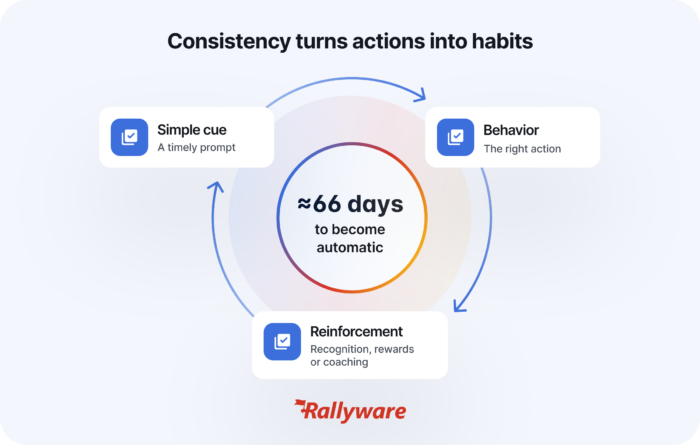
This is the structural flaw in most productivity strategies: they treat behavior change as an event instead of a process. A kickoff call, a new incentive, a refreshed playbook, each one produces a short spike in activity that decays almost as quickly as it appeared, because nothing in the system reinforces the behavior once the initial push is over.
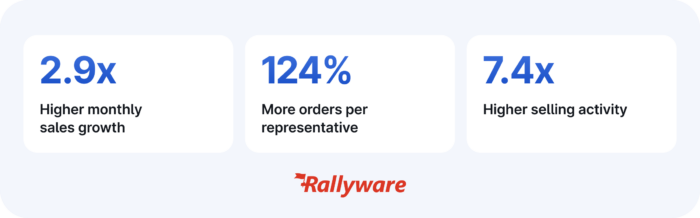
Rallyware’s own data across direct selling organizations reflects the cost of that gap, and the payoff when it’s closed. Organizations that reinforce selling behaviors systematically, rather than episodically, see 2.9x higher monthly sales growth, 124% more orders per representative, and 7.4x higher selling activity compared to organizations relying on manual, reactive management.
What Behavioral Reinforcement Actually Looks Like
Closing the productivity gap doesn’t mean adding another dashboard for leaders to check or another course for distributors to sit through. It means building an operating rhythm where the right selling behaviors are prompted, supported, and reinforced continuously, not just during a campaign window.
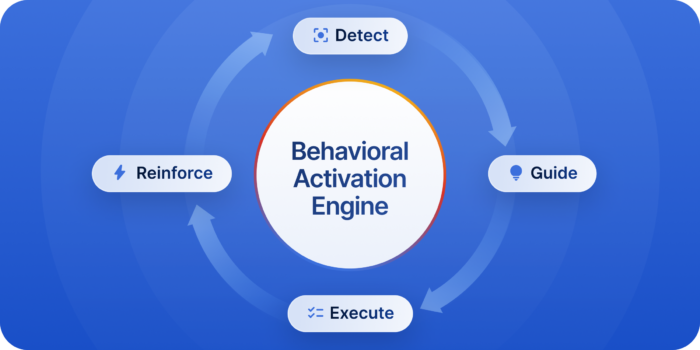
In practice, that means four things working together:
- Detection. The organization can see, in real time, when follow-up, outreach, or order-placement behaviors start to lag, not weeks after the revenue impact shows up in a report.
- Contextual guidance. Distributors get a specific next action at the moment it matters, instead of a general reminder to “sell more” or “reach out to customers.”
- Frictionless execution. The tools to act, contact management, messaging templates, order links, sit right next to the prompt, so intention converts into action in one or two steps.
- Reinforcement. Recognition, incentives, and leader coaching close the loop, so the behavior compounds instead of decaying once the initial nudge wears off.
This is the difference between a platform that informs the field and one that activates it. An LMS distributes content. A CRM logs what already happened. Neither one, on its own, changes what a distributor does next Tuesday morning.
The Leadership Question Worth Asking This Quarter
If your organization is like most, you can already answer the lifecycle-stage version of this question: you know your average order value, your recruiting numbers, your retention curve. What’s harder to answer is the behavioral version:
Between campaigns, what is actually reinforcing consistent selling behavior across your field, and how would you know if it stopped working?
For most direct selling organizations, the honest answer is “leadership pushes” and “hope.” That’s not a system. It’s a series of manual interventions that depend entirely on individual leaders noticing a problem before it becomes a revenue story.
The organizations pulling ahead are the ones treating behavioral consistency as infrastructure, something built once and running continuously, rather than a message repeated at every convention. Compensation plans define what good behavior looks like. The question is whether anything in your organization is actively making sure it happens, every week, for every distributor, not just the ones already succeeding.
FAQ
Why is direct selling productivity so inconsistent across the field, even with the same compensation plan?
Compensation plans define what behavior should be rewarded, but they don’t guarantee that behavior actually happens consistently. Without systematic prompting and reinforcement, distributors default to sporadic effort driven by individual motivation rather than a reliable operating rhythm.
Isn’t more sales training the fastest way to fix a productivity gap?
Training builds knowledge, not habits. Behavioral research shows new actions need weeks of repetition to become automatic. Training alone doesn’t provide that ongoing reinforcement, which is why productivity gains from a single training push tend to fade quickly.
What’s the difference between tracking productivity and activating it?
Tracking (via a CRM or dashboard) tells leadership what already happened. Activation surfaces the next-best action to a distributor at the moment it matters and makes it easy to execute, closing the loop between insight and behavior instead of just reporting on the gap.
How quickly can an organization see results from behavioral reinforcement?
Results vary by organization and starting maturity, but Rallyware customers activating productivity behaviors systematically have seen measurable lifts in monthly sales growth and order volume within a pilot cohort before scaling further. A working session is the fastest way to baseline your own numbers.
News and Insights on Workforce Training & Engagement
We’re among top-notch eLearning and business engagement platforms recognized for effective training and talent development, helping to empower distributed workforces
Subscribe