From Zero to Beauty Hero: A Direct Selling Success Story
Your Top Performers Are Already Showing You the Playbook. Why Isn’t the Rest of Your Field Running It?
Every direct selling organization has them: a tier of distributors who seem to crack the code. They activate fast, build their teams consistently, maintain selling rhythms through market fluctuations, and progress through leadership ranks while the majority of the network stalls or drops off. They are not anomalies. They are a blueprint.
The uncomfortable reality is that most organizations already know what these top performers do differently. They have the behavioral data. They have the field insights. In many cases, they’ve studied their best people closely enough to articulate exactly what separates a distributor who builds a durable business from one who exits within 90 days.
What they don’t have is a system that takes that knowledge and reliably delivers it to everyone else, at the moment it would actually change behavior.
That gap, between knowing what works and operationalizing it at scale, is one of the central questions we explored in a recent Rallyware workshop session with a major direct selling organization. Here’s what surfaced, and why it matters for any network trying to move from unpredictable to predictable revenue.
The Playbook Exists. It’s Just Trapped.
One of the most striking moments comes when an organization’s leadership team is asked a simple question: what do your top performers consistently do that your average performers don’t?
The answers come quickly. Top performers prospect within the first 30 to 45 days of joining. They place their first order early. They support new recruits actively in the critical window right after joining, not weeks later. They maintain a consistent selling rhythm instead of sporadic bursts of activity. They follow structured paths to rank advancement rather than freelancing their way through qualification criteria.
None of this is a secret. Leadership already has field data on best practices from their top performers. The problem, stated plainly: they just haven’t had the right channel to use it.
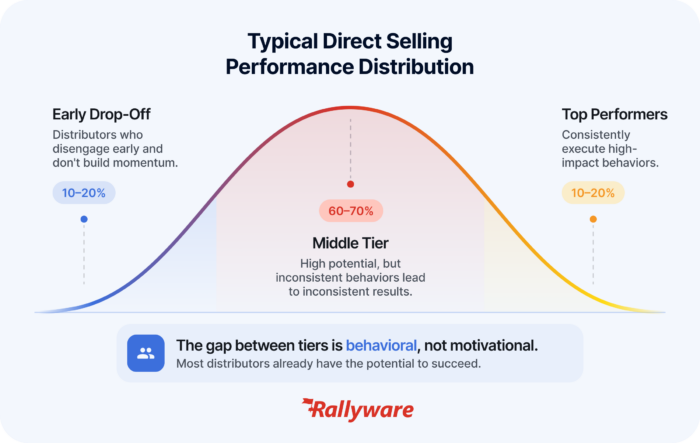
This is the defining challenge of scale in direct selling. The playbook isn’t missing. It’s inaccessible. It lives in the habits of your top 10 or 20 percent, occasionally documented in training materials that reach a fraction of the field, and almost never surfaced at the specific moment a mid-tier or new distributor needs it most.
The result is a network that generates highly uneven results not because different people have fundamentally different potential, but because the behaviors that drive success are not being consistently activated across the full population.
Why “More Training” Doesn’t Close the Gap
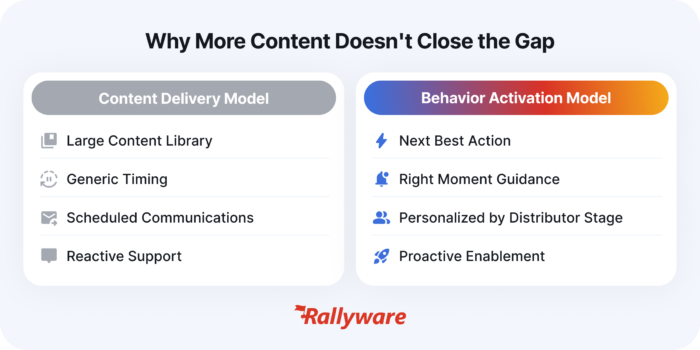
The instinct in most organizations when confronted with this performance gap is to create more content. More training modules. More product videos. More onboarding materials. Better documentation of what top performers do.
This instinct is understandable and almost entirely wrong.
The problem isn’t that distributors lack access to information about what success looks like. In many mature direct selling organizations, the content library is enormous. Onboarding portals are comprehensive. Leadership development tracks are thoroughly documented. The issue is that none of that content reaches a distributor at the exact moment they face the decision that will either build or break their momentum.
Consider what actually happens in the critical first 48 to 72 hours after a new distributor joins. The behaviors that predict long-term success are narrow, time-sensitive, and highly dependent on the distributor knowing exactly what to do next.
- Taking a first meaningful action
- Placing an initial order
- Beginning to build a prospect list
A training library doesn’t answer that question. A scheduled onboarding email doesn’t either. What answers it is a personalized, real-time prompt that says: here is the single most important thing to do right now, based on where you are and what your most successful peers did at this exact stage.
This reframe, from content delivery to behavior activation, is the methodological shift that separates modern performance enablement from legacy training approaches. The goal is not to educate. The goal is to reliably produce the next right action, at the right time, for every distributor in the network.
Turning Top Performer Data Into a System Everyone Can Run
So what does it actually look like to operationalize top performer behaviors across a full network? It starts not with technology decisions, but with a much more fundamental question: what specific actions, taken consistently, drive each measurable outcome we care about?
This sounds obvious. In practice, most organizations have never done it rigorously. They have goals: increase first-order rate, improve 90-day retention, accelerate rank advancement. They have KPIs to measure those goals. What they are missing is the behavioral bridge: the specific, observable actions that connect daily distributor activity to those outcomes.
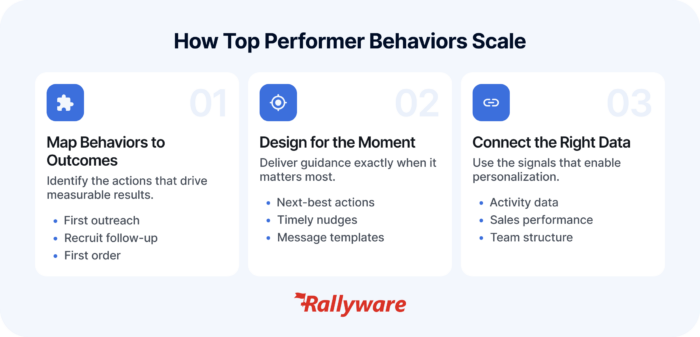
This behavioral bridge is built in three steps:
Step 1: Map behaviors to outcomes, not to features
The starting point is identifying, for each lifecycle stage and each KPI, the specific behaviors that top performers consistently execute. Not broadly, “they prospect”, but precisely: they reach out to initial contacts within the first week of joining, they build a prospect pool of 50 to 80 names within 30 to 45 days, they follow up on stalled prospects within 48 hours. This level of specificity is what makes the playbook replicable.
Step 2: Design for the moment, not the module
Once behaviors are defined, the question becomes: what does a distributor need, at the exact moment that behavior should happen, to make it easy to execute? This is the experience design question. It is not “what content should we put in the LMS?” It is “what does a distributor who just joined three days ago and has not yet contacted a prospect need to see when they open the app right now?” The answer might be a single nudge. A pre-written message template. A ranked list of who to call first. The delivery is minimal; the timing is everything.
Step 3: Connect the data that makes personalization possible
Behavior activation at scale requires data, but not all data equally. Some data needs to flow in real time (new user activation, status changes, team structure updates) while other data can be updated on a regular cadence (sales and compensation), and still other data is relatively static (profile information). Getting this data architecture right is not a technology problem. It is a design decision about which behaviors require which data, and ensuring that data is available when and where it needs to enable the experience.
The Five Levers That Make Behavior Stick
Identifying the right behaviors and designing the right moments is necessary. It is not sufficient. One of the clearest lessons from working with direct selling organizations at scale is that behavior change requires a sustained architecture, not a single intervention. A nudge at day three does not produce a habit. A recognition at the first milestone does not guarantee a second.
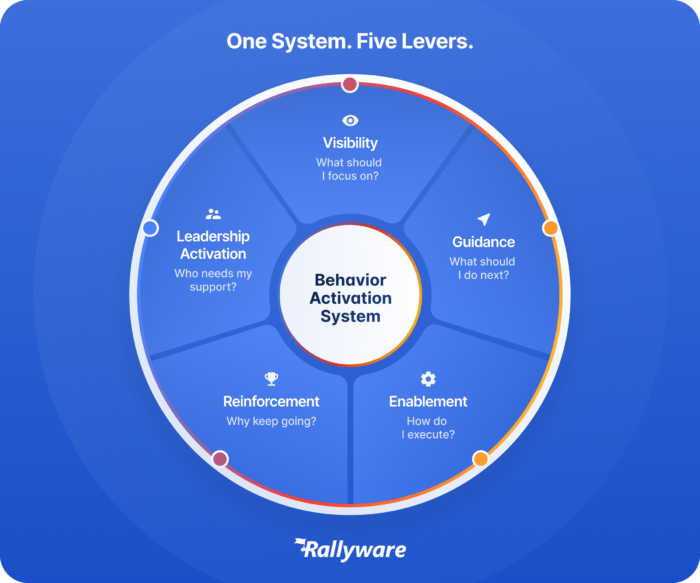
There are five distinct intervention types, each playing a different role in converting a one-time action into a durable pattern:
Visibility: Distributors cannot act on what they cannot see. Before any guidance or nudge is effective, the distributor needs a clear, real-time picture of where they stand: their progress, their team’s activity, the gap between where they are and where they need to be. The first question every enablement experience needs to answer is: what should I focus on, and why?
Guidance: Visibility creates awareness. Guidance converts awareness into action. This is the next-best-action layer, not a library of options, but a specific recommendation: do this, now, because it is the highest-value action available to you at this moment. The specificity is what makes guidance actionable rather than merely informative.
Enablement: The moment a distributor is ready to act, friction is the enemy. Enablement means every tool needed to execute the guided action, a message template, a product script, a contact management view, a sharing tool, is immediately available. Intent without infrastructure produces hesitation. Hesitation produces inaction.
Reinforcement: A behavior executed once is not a behavior. Reinforcement, through recognition, incentives, reminders, and leaderboard visibility, is what converts a single action into a repeatable pattern. This layer is often underinvested in direct selling platforms because it feels secondary to guidance and content. It is not. It is the mechanism through which habits form.
Leadership Activation: At scale, individual behavior change is not enough. Leaders multiply the impact of every intervention by identifying who needs support, coaching proactively, and modeling the behaviors they want to see replicated across their downline. The critical enablement question for leaders is not “what should I know?” but “who needs my attention right now, and what should I say?”
The Question Every Direct Selling Leader Should Ask This Quarter
The most useful takeaway isn’t a framework or a feature set. It’s a diagnostic question that reframes how to think about network performance entirely.
Not the aspiration. The specific, observable, time-stamped actions. The first prospecting outreach. The follow-up cadence. The way they support a new recruit in week one versus week four. The pattern of activity that precedes a rank advancement versus the pattern that precedes a quiet exit.
If your organization can answer that question with specificity, you have the raw material for a behavior activation system that can genuinely move the middle of your network. If you cannot, if the answer is “we know broadly what they do but haven’t mapped it precisely”, that is the work to do first. Not the platform selection. Not the content audit. The behavioral mapping.
The organizations that will build durable, compounding fields over the next several years are not the ones with the most content or the most sophisticated LMS. They are the ones that figured out what their best people do, built a system to replicate it at scale, and instrumented the data to keep improving it. The playbook already exists inside your network. The only question is whether you build the infrastructure to run it.
FAQ
Q: What is a top performer playbook in direct selling?
A top performer playbook is a documented set of specific, observable behaviors that your highest-performing distributors consistently execute at each stage of their lifecycle, onboarding, prospecting, recruiting, selling, and leadership development. Unlike generic best-practice guides, a true playbook is grounded in your organization’s own behavioral data: what your best people actually do, when they do it, and in what sequence. The goal is not to inspire, it’s to make those behaviors replicable for the full network.
Q: Why do top performers in direct selling outperform average distributors?
Research consistently shows that performance gaps in direct selling are primarily behavioral, not motivational. Top performers tend to take specific actions earlier in their lifecycle (first order, first prospect contact, first recruit support), maintain consistent activity rhythms rather than sporadic bursts, and follow structured paths through qualification and rank advancement. The gap is not that average distributors don’t want to succeed, it’s that they don’t have a system delivering the right action prompt at the right moment the way top performers’ habits and sponsors naturally do.
Q: How can direct selling companies replicate top performer behaviors across their network?
Replicating top performer behaviors at scale requires three things: first, mapping those behaviors precisely at each lifecycle stage (not broadly, but in specific observable actions with timing); second, designing an enablement experience that surfaces the right next action at the right moment for every distributor, regardless of their sponsor’s attentiveness; and third, connecting the behavioral and performance data that makes personalization possible. Platforms like Rallyware are built to deliver all three, using AI to detect where each distributor is in their journey and serve the next-best-action accordingly.
Q: What data do direct selling organizations need to enable personalized distributor journeys?
Three categories of data are foundational: profile and genealogy data (who the distributor is, their market, their upline/downline relationships), engagement and critical business activity data (login patterns, CRM activity, training completion, inactivation and re-activation signals), and sales and performance data (order volume, rank, group volume, compensation milestones). Not all of this data needs to flow at the same cadence, real-time updates matter for activation triggers and status changes, while sales data can sync on a regular schedule. Getting the data architecture right is as important as the experience design itself.
Q: What is the difference between distributor training and distributor behavior activation?
Training is designed to build knowledge. Behavior activation is designed to produce a specific action at a specific moment. The distinction matters because knowledge acquisition and behavioral execution are not the same thing, and most direct selling performance gaps are not knowledge gaps. A distributor who doesn’t prospect in their first week usually knows they should prospect. What they lack is a system that makes prospecting the obvious, frictionless next step the moment they open their app. Behavior activation platforms address this by combining real-time visibility, next-best-action guidance, execution tools, and reinforcement into a single experience designed for the moment of decision, not for a training session two weeks prior.
Q: How does leadership activation improve distributor performance in direct selling?
Leaders are the highest-leverage point in any direct selling network because their influence multiplies across their entire downline. When leaders have real-time visibility into who on their team is drifting toward inactivity, who has just reached a milestone that deserves recognition, and who needs a specific coaching intervention, they can act with precision rather than intuition. Leadership activation, giving leaders the right data and the right prompts at the right time, is what converts a passive upline into an active performance driver. At scale, this layer is what allows the behaviors of the best sponsors to propagate across teams that would otherwise be operating without consistent guidance.
News and Insights on Workforce Training & Engagement
We’re among top-notch eLearning and business engagement platforms recognized for effective training and talent development, helping to empower distributed workforces
Subscribe